NCUIH May Policy Update: 2026 Annual Conference and HIll Day Recap, Special Diabetes Program for Indians, and Indian Health Service Funding updates and more!

In this Edition:
- 💰 Notice of Funding Opportunities
- 🏛️ NCUIH 2026 Annual Conference and Hill Day Recap
- 📜 Public Health Service Access Act (S. 4416) Introduced
- 💰 FY 2027 Funding Updates: House Proposes Increased Funding for IHS
- 🏛️ 21 Senators Support Indian Health Service and Urban Indian Health Funding
- 🩺 Special Diabetes Program for Indians Updates
- 💊 Federal Medical Assistance Percentage Updates
- 📅 FY 2028 Department of Health and Human Services Annual Tribal Budget Consultation and Secretary’s Tribal Advisory Committee Recap
- 💉 NCUIH Submits Comments to Health Resources and Services Administration on 340B Rebate Pilot Program
- 💻 NCUIH Comments on Telehealth Prescribing Flexibility,
- 🏛️Center for Indigenous Innovation and Health Tribal Advisory Committee Accepting Nominations
- 📅 Upcoming Events and Policy Dates
- 📝 ICYMI: Recent NCUIH Policy Blog Posts
Current Funding Opportunities
SAMHSA | Now Live – Garrett Lee Smith State/Tribal Suicide Prevention and Early Intervention Due: June 15, 2026
- Supports UIOs, States, and Tribes in implementing youth suicide prevention and early intervention strategies for individuals up to age 24. NOFO Number: SM-26-010 · CFDA: 93.532. Posted May 15, 2026.
- Full details: https://www.samhsa.gov/grants/grant-announcements/sm-26-010?utm_source=SAMHSA&utm_campaign=fc31c4dbcd-EMAIL_CAMPAIGN_2026_05_14_03_40&utm_medium=email&utm_term=0_-fc31c4dbcd-169980728
VA | Staff Sergeant Fox Suicide Prevention Grant Program Due: June 12, 2026
- Funds community-based organizations to provide or coordinate non-clinical suicide prevention services for Veterans, Active-Duty Service Members, and their families.
- Award: $100,000 – $750,000 · Total program funding: $111M
- Full details: https://www.mentalhealth.va.gov/ssgfox-grants/
IHS | Phase 2 Produce Prescription Pilot Program (P4) Due: June 22, 2026
- Supports produce prescription programs in Tribal communities, including UIOs, enabling AI/AN individuals to receive produce prescriptions redeemable for nutritious foods through approved community organizations or health care providers. UIOs are eligible. Up to 18 awards expected.
- Award: $200,000 – $250,000 · Total pool: $3.5M
- Full details: https://www.grants.gov/search-results-detail/362483
IHS | IHS FY 2026 Urban Emergency Fund (UEF) Due: No fixed deadline — submit as soon as reasonably practicable after an emergency occurs.
- Helps UIOs address costs associated with one-time, non-recurring emergencies and disaster relief efforts.
- Award: Up to $250,000 (subject to availability of appropriations; not guaranteed)
- Full details: Submit a written request to the applicable IHS Area Director, with copies to the Area Chief Contracting Officer and the UIO’s Contracting Officer Representative.
NCUIH’s 2026 Annual Conference – Recap

NCUIH held its 2026 Annual Conference in Washington, D.C., from April 27–30, marking the 50th anniversary of the Indian Health Care Improvement Act. Key highlights from this year’s conference included:
- Rep. Pingree
- Department of Health and Human Services updates
- Substance Abuse and Mental Health Services Administration updates
- Centers for Medicare and Medicaid Services video presentation
NCUIH’s 2026 Hill Day – 60 Visits!
NCUIH’s 2026 Hill Day was a major success, with 60 congressional office visits. Attendees urged Congress to take action on key policy priorities, including:
- Urban Indian Health Funding
- 100% Federal Medical Assistance Percentage for Urban Indian Organizations
- Substance Abuse and Mental Health Services Administration Grants
NCUIH Bi-Partisan Legislation Introduced to Strengthen Urban Indian Organization Workforce
Public Health Service Access Act (S. 4416)
The Public Health Service Access Act is a legislative amendment to the Public Health Service Act that would authorize the Indian Health Service to detail U.S. Public Health Service Commissioned Officers directly to Urban Indian Organizations.
- Introduced on April 28 by Sen. Murkowski (R-AK), Sen. Murray (D-WA), Sen. Tillis (R-NC), and Sen. Cortez Masto (D-NV)
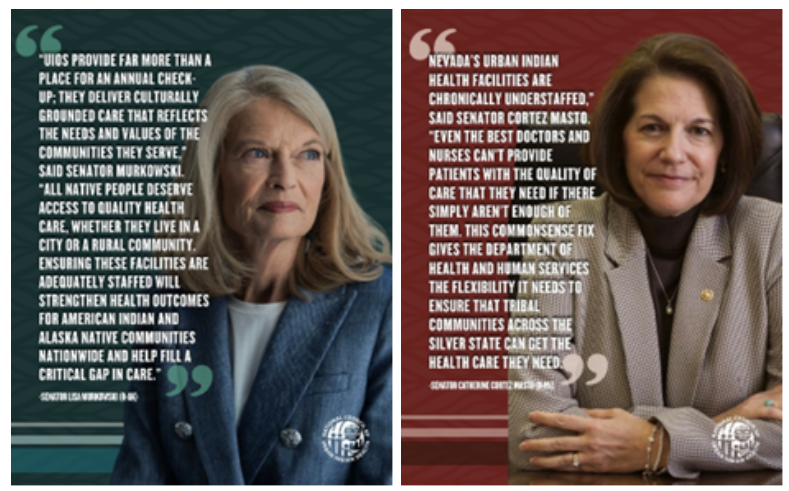
Next Steps: The bill has been referred to the Senate Committee on Health, Education, Labor and Pensions.
FY 2027 Funding Updates: House Proposes Increased Funding for IHS, Congressional and Federal Support for UIOs
On May 20, The House released their FY 2027 Interior Appropriations Bill which proposes:
- $8.69 billion for Fiscal Year 2027 for the Indian Health Service, which is an increase of $639.8 million above the Fiscal Year 2026 enacted level.
- $6.06 billion in Fiscal Year 2028 advance appropriations.
NCUIH submitted written testimony to House and Senate Interior and Labor-HHS Appropriations Subcommittees, requesting increased funding for urban Indian health and protection of key Indian Country programs.
FY 2027 Appropriations discussions are underway:
- House Interior Subcommittee Markup was held on 5/21/2026 and the full Committee markup is scheduled for June 3.
- House Labor-HHS subcommittee and full committee markups are scheduled for June 5th and 9th.
21 Senators Support Indian Health Service and Urban Indian Health Funding
On April 15, 21 U.S. Senators signed a dear-colleague letter to Senate Interior Appropriations Committee leadership for FY 2027 funding. NCUIH conducted outreach to Members of Congress in support of this effort, which included requests for
- Full funding for Urban Indian Health and the Indian Health Service
- Maintaining Advance Appropriations for the Indian Health Service
Read more on NCUIH’s Policy Resource Center.
Indian Health Service Chief of Staff Clayton Fulton highlights importance of UIOs at House Interior Appropriations Subcommittee budget hearing to examine the IHS Fiscal Year 2027 Budget Request
“Our urbans do incredible work for the amount of dollars that we provide them each year. They do incredible access, and we work very diligently with them and the National Council on urban Indian health to make sure that they are well accessed, whether that’s creating access to our grant programs like behavioral health, additional grants that we have in urban programs and securing them so that has been primarily our partnership, and continue to work with them.”
— Indian Health Service Chief of Staff Clayton Fulton, April 30 Indian Health Service Budget Hearing
Special Diabetes Program for Indians Updates: Funding Status, Budget Context, and Congressional Implications
The Special Diabetes Program for Indians received $200 million in FY 2026 — the highest funding level in the program’s history, representing a 25% increase. Key updates include:
- FY 2026 Funding: $200 million enacted; highest level in Special Diabetes Program for Indians history (+25% increase). Current authorization expires December 31, 2026.
- FY 2027 President’s Budget: The $49.4 million reflected in the FY 2027 President’s Budget represents approximately one quarter of the annual $200 million level — roughly three months of funding before the authorization expires — minus $1 million in automatic sequestration cuts.
- Program Risk: No funding authority after January 1, 2027, without reauthorization. 31 UIOs receive SDPI grants. A lapse in authorization would cut off diabetes prevention and treatment services at tribal and urban Indian programs.
Pending Legislation:
- Special Diabetes Program Reauthorization Act of 2025 (S.2211) – Introduced by Senators Collins and Shaheen on July 8, 2025, to reauthorize both the Special Diabetes Program for Type 1 Diabetes and the Special Diabetes Program for Indians.
- House companion bill, H.R. 5461, was also introduced.
Congress must act to pass S. 2211 or comparable reauthorization legislation before December 31, 2026, to prevent a lapse in program authority.
Read more on NCUIH’s blog.
FY 2028 Department of Health and Human Services Annual Tribal Budget Consultation – Recap
On April 24, NCUIH submitted formal comments to the FY 2028 HHS Annual Tribal Budget Consultation. Key requests included:
- Funding for Urban Indian Health and IHS at the full amount requested by Tribes
- Mandatory appropriations for the Indian Health Service and exemption of HHS Indian Country funding from sequestration
- UIO inclusion in budget formulation
- Legislative fix to set FMAP at 100% for Medicaid services provided at UIOs.
The FY 2028 HHS Annual Tribal Budget Consultation was held April 21-22 in Washington, D.C. Support was shown for urban Indian health as HHS leadership highlighted their visits to UIOs and Tribal leaders raised that the proposed decrease for Urban Indian Health in the FY 2027 President’s Budget threatens UIOs and supported 100% Federal Medical Assistance Percentage (FMAP) for UIOs.
Department of Health and Human Services Secretary’s Tribal Advisory Committee Meeting – Recap
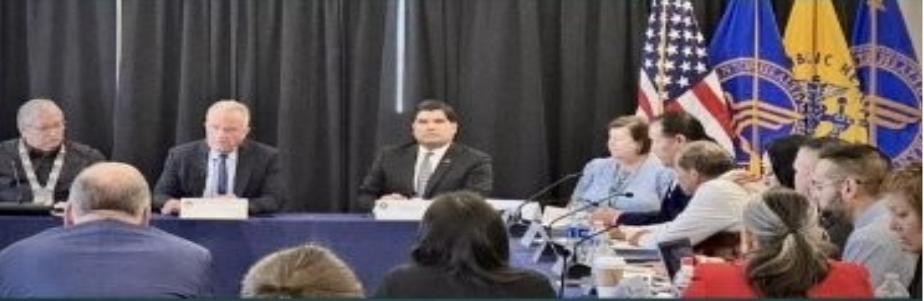
On April 23, NCUIH attended the HHS Secretary’s Tribal Advisory Committee (STAC) meeting.
Key highlights include:
- Secretary Kennedy named Urban Indian Organizations — including Native Health, Native American Connections, and Oklahoma City Indian Clinic — as models for traditional food integration and traditional healing-based substance use treatment.
- NCUIH acknowledged the Secretary for his support of 100% FMAP for UIOs, which he committed to working with Senator Cantwell on at an April 22 Senate Finance committee Hearing.
SAMHSA Issues Updated Harm Reduction Funding Guidance – What Can and Cannot Be Supported
SAMHSA has issued updated guidance clarifying what supplies and services can and cannot be supported with SAMHSA funding.
We encourage UIOs to review the Dear Colleague letter to assess any implications for your specific grants.
NCUIH Submits Comments to Health Resources and Services Administration Supporting Indian Health Care Provider Exemption from 340B Rebate Pilot Program
On April 20, NCUIH submitted comments to the Health Resources and Services Administration (HRSA) in response to its Request for Information on the 340B Rebate Model Pilot Program, which poses significant administrative and financial burdens for UIOs.
- Requests include tribal consultation/urban confer and exemption for IHS, Tribal, and UIO providers from any rebate-based 340B pilot model.
NCUIH and CMS Tribal Technical Advisory Group Support Flexibility in Telehealth Prescribing for Urban Indian Organizations
The Drug Enforcement Administration (DEA) is conducting Tribal consultation on a framework for prescribing controlled substances via telemedicine and is seeking input on the unique healthcare access challenges facing urban American Indian and Alaska Native communities.
- May 8 – NCUIH submitted comments to the DEA highlighting the statutory exclusion of UIOs from the existing Indian health telemedicine exception.
- May 7 – NCUIH worked with UIOs and the CMS Tribal Technical Advisory Group (TTAG) in sending a letter to DEA, which included urban American Indian and Alaska Native patient access barriers, the critical role of audio-only telehealth, and the need for telehealth flexibilities for patient treatment.
HHS is Accepting Nominations for the Center for Indigenous Innovation and Health Tribal Advisory Committee
The HHS Office of Minority Health is accepting nominations for the Center for Indigenous Innovation and Health Tribal Advisory Committee (CIIH TAC).
- TAC Membership: 3 delegates from IHS geographic areas and 3 National At-Large Member positions (must be nominated by an elected Tribal leader).
- Nomination accepted until roles filled
Learn more on the Federal Register Notice.
Upcoming Events and Policy Dates
- May 27 — Department of Veterans Affairs I/T/U Reimbursement Agreement Webinar (link)
- June 2 — Indian Health Service Tribal Leaders Diabetes Committee Quarterly Meeting (virtual)
Recent NCUIH Policy Blogs
- Special Diabetes Program for Indians Faces Funding Cliff Without Congressional Reauthorization May 22, 2026/in Policy Blog/by NCUIH
- IHS Announces SDPI Grant Supplements, Consultation and Confer May 21, 2026/in Policy Blog/by Meredith Raimondi
- NCUIH Honors Senator Tina Smith for Her Leadership and Legacy in Urban Indian Health May 20, 2026/in Policy Blog, Press Release/by NCUIH
- Urban Indian Organizations’ Programming Profile May 18, 2026/in Research/by NCUIH
- Murkowski, Tillis, Murray, and Cortez Masto Introduce Bipartisan Bill to Strengthen Urban Indian Organization Workforce May 14, 2026/in Policy Blog/by Jeremy Grabiner
- NCUIH 2026-2027 Policy Priorities Released: Need for Full and Stable IHS Funding, Medicaid Parity for UIOs, and Investments in Native Behavioral Health Programs May 13, 2026/in Policy Blog/by Jeremy Grabiner
- CMS Releases Guidance to States on Implementation of the One Big Beautiful Bill Act 6-Month Medicaid Redeterminations – Includes AI/AN Exemption May 13, 2026/in Policy Blog/by Alex Sampson
- 21 Senators Request Protected Funding for IHS and Increased Resources for Urban Indian Health in FY 2027 May 13, 2026/in Policy Blog/by Jeremy Grabiner
- NCUIH Honors Pfizer, Ishkode Fund, and Urban Indian Health Leaders May 12, 2026/in Policy Blog, Press Release/by River Carroll
- NCUIH Honors Chairman Tom Cole and Ranking Member Chellie Pingree with Urban Indian Health Champion Award May 6, 2026/in Policy Blog, Press Release/by Meredith Raimondi
- NCUIH Honors HHS Senior Advisor Mark Cruz with Excellence in Public Service Award May 6, 2026/in Policy Blog, Press Release/by Meredith Raimondi
About NCUIH
The National Council of Urban Indian Health (NCUIH) is a national representative for the 41 Urban Indian Organizations contracting with the Indian Health Service under the Indian Health Care Improvement Act. NCUIH is devoted to the support and development of high quality and accessible health and public health services for American Indian and Alaska Native people living in urban areas.
NCUIH respects and supports Tribal sovereignty and the unique government-to-government relationship between our Tribal Nations and the United States. NCUIH works to support those federal laws, policies, and procedures that respect and uplift Tribal sovereignty and the government-to-government relationship. NCUIH does not support any federal law, policy, or procedure that infringes upon or in any way diminishes Tribal sovereignty or the government-to-government relationship.