PRESS RELEASE: NCUIH Board President Robyn Sunday-Allen Joins Tribal Leaders and Senate Champions to Celebrate Introduction of the Native Children’s Commission Implementation Act
FOR IMMEDIATE RELEASE
WASHINGTON, D.C. (July 24, 2026) – Yesterday, the National Council of Urban Indian Health (NCUIH) proudly joined Tribal leaders, Native youth advocates, and congressional champions on Capitol Hill to celebrate the introduction of the Senate’s Native Children’s Commission Implementation Act. This bi-partisan legislation would address longstanding challenges facing Native children and families across child welfare, education, health care, juvenile justice, housing, workforce development, nutrition, and data systems, and represents one of the most significant investments in Native children and families in a generation.
NCUIH Board President Robyn Sunday-Allen (Cherokee Nation), who also serves as Chief Executive Officer of the Oklahoma City Indian Clinic (OKCIC), participated in a day of action hosted alongside the National Congress of American Indians (NCAI), Cook Inlet Tribal Council, Tribal leaders, Native youth representatives, and the Senate Committee on Indian Affairs.
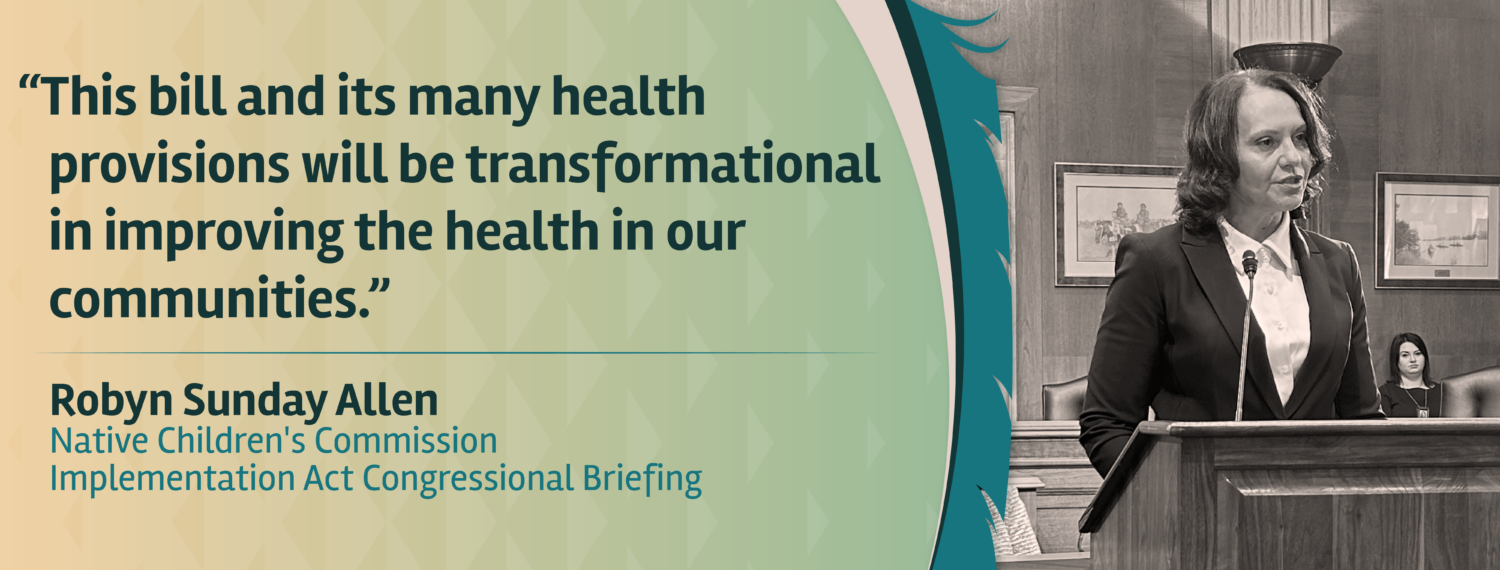
“I know firsthand the difference that quality health care makes in the lives of our mothers and children, which is why I know that this bill and its many health provisions will be transformational in improving the health in our communities,” said Robyn Sunday-Allen, NCUIH Board President and CEO of Oklahoma City Indian Clinic during a congressional briefing. “The Native Children’s Commission Implementation Act presents real change and real solutions to the many challenges that our children, our youth, and our communities face today.”
The day’s events included:
- Congressional Briefing in the Senate Committee on Indian Affairs (SCIA) Hearing Room, followed by a press conference, where Robyn Sunday-Allen, Native youth, and Tribal leaders provided an overview of the legislation and highlighted its potential impact on Native communities. Sunday-Allen discussed the important role of Urban Indian Organizations (UIOs) in advancing health equity and ensuring Native children and families living in urban areas benefit from the bill’s potential investments.
- Reception, honoring the introduction of the legislation.
Native Children’s Commission Implementation Act Would Deliver Historic Investments for Native Children and Strengthen Urban Indian Health Inclusion
The Native Children’s Commission Implementation Act builds upon the recommendations of the Alyce Spotted Bear and Walter Soboleff Commission on Native Children, which submitted its final report to Congress and the President in 2024 after extensive engagement with Tribal leaders, youth, elders, and service providers nationwide. The legislation would provide nearly $1 billion in new funding for Indian Country families, including approximately $700 million available immediately without requiring additional appropriations.
NCUIH strongly supports the legislation’s inclusion of UIOs in several key health, research, and data initiatives. Among other provisions, the bill would make UIOs eligible for Tribal perinatal workforce demonstration grants, include UIO representation on new federal advisory committees at the Health Resources and Services Administration (HRSA), the Substance Abuse and Mental Health Services Administration (SAMHSA), and the National Institutes of Health (NIH), and support partnerships with UIOs to improve Native infant and maternal health data.
Learn More
NCUIH recently published an analysis of the Native Children’s Commission Implementation Act highlighting key provisions for UIOs across health, research, and data initiatives:
- NCUIH Analysis: “Senators Murkowski and Schatz Introduce Native Children’s Commission Implementation Act, Key Inclusions for Urban Indian Organizations Across Health, Research, and Data Initiatives” (July 16, 2026).
About NCUIH
The National Council of Urban Indian Health (NCUIH) is a national representative for the 41 Urban Indian Organizations contracting with the Indian Health Service under the Indian Health Care Improvement Act. NCUIH is devoted to the support and development of high quality and accessible health and public health services for American Indian and Alaska Native people living in urban areas.
NCUIH respects and supports Tribal sovereignty and the unique government-to-government relationship between our Tribal Nations and the United States. NCUIH works to support those federal laws, policies, and procedures that respect and uplift Tribal sovereignty and the government-to-government relationship. NCUIH does not support any federal law, policy, or procedure that infringes upon or in any way diminishes Tribal sovereignty or the government-to-government relationship.
###
NCUIH Contact: Meredith Raimondi, Senior Vice President of Policy and Communications, mraimondi@ncuih.org