In this Edition:
- Questions for UIOs: Request for Input and Feedback
- Senate Committee on Indian Affairs Holds Nomination Hearing for Mark Cruz as Indian Health Service Director
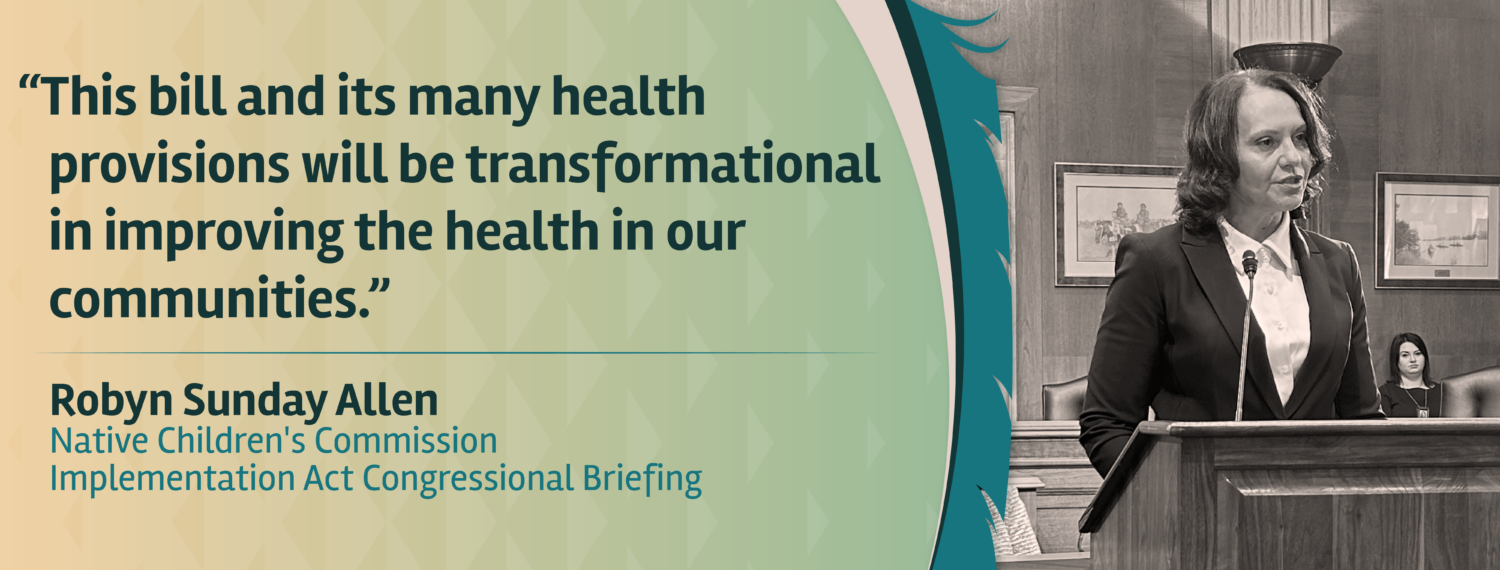
- Senators Murkowski and Schatz Introduce Native Children’s Commission Implementation Act
- Fiscal Year 2027 Appropriations Status and Updates
- Federal Medical Assistance Percentage (FMAP) Updates
- Centers for Medicare & Medicaid Services Tribal Technical Advisory Group July Face-to-Face Meeting
- Upcoming Comments Due July 31: Centers for Medicare & Medicaid Services Interim Final Rule on H.R. 1 Implementation
- Submitted Comments: Office of Management and Budget Regulation for Federal Financial Assistance Rule
- Centers for Disease Control and Prevention Maternal Mortality Review Committees Updates
- New NCUIH Maternal Health and Social Determinants of Health Resources
- Save the Date: UIO and Federal Partners Summit in Washington, D.C.
- Upcoming Events, Policy Dates, and Funding Opportunities
Questions for UIOs: Request for Input and Feeback
- UIO Listening Session with the Indian Health Service (IHS) Division of Behavioral Health (DBH):
- NCUIH is facilitating a virtual UIO listening session with IHS DBH on September 17, 2026, at 1:00 PM ET. Register to attend at ncuih.org/events. To ensure DBH’s remarks are responsive to UIOs’ needs, please let us know any questions you have for DBH, behavioral health challenges and successes at your UIO, and any topics you want covered during the listening session.
- Lastly, NCUIH is exploring whether there are federal or state policy barriers that make it harder for UIOs to prescribe, obtain, manage, or pay for medications for patients.
- Question for UIOs: Are there barriers your organization is experiencing that we should understand? Please indicate if the barrier is primarily a policy, reimbursement, workforce, pharmacy, or administrative barrier.
- Responses can be sent to policy@ncuih.org
IHS Seeking Written Feedback from UIOs on the Use of $70 Million in Special Diabetes Program for Indians Funding
On July 13, IHS released a Dear Tribal Leader and Urban Indian Organization Leader to initiate Tribal Consultation and Urban Confer to request feedback and recommendations regarding the use of approximately $70 million in Special Diabetes Program for Indians (SDPI) funding ($50 million associated with the Fiscal Year (FY) 2026 SDPI funding increase and $20 million in one-time unobligated SDPI funding).
Read more on our blog.
IHS is seeking written responses to the following questions:
- Current SDPI grant recipients will receive a Calendar Year 2026 administrative grant supplement totaling 25% of their annual SDPI grant award using one-time, unobligated funding.
- What IHS flexibilities do you suggest to help current grantees fully spend the additional supplemental SDPI funds within the grant period?
- What educational resources or technical assistance would your SDPI program request to fully spend supplemental SDPI funds by December 31, 2027?
- What is the best way to distribute the additional SDPI funds to improve current efforts in treatment, prevention, and care coordination within existing SDPI scopes of work?
- How should the IHS prioritize the use of $70 million to achieve the greatest impact?
- What are the most significant diabetes risk factors affecting your community that could be addressed through a prevention-focused SDPI initiative?
- What recommendations do you have for structuring a prevention and wellness program that supports Tribal sovereignty, cultural practices, local decision-making, and community-defined health priorities?
- How can the IHS best support prevention efforts that focus on children, youth, and families to improve long-term health outcomes and prevent type 2 diabetes and related chronic diseases?
- What are your recommendations for the future direction of SDPI, including opportunities to strengthen the program’s impact, flexibility, sustainability, and responsiveness to Tribal and Urban Indian community needs?
NCUIH is requesting that UIOs email policy@ncuih.org with their recommendations and feedback on these questions to help inform our efforts.
Comments due to IHS by August 12, 2026
Murkowski, Schatz Introduce Native Children’s Commission Implementation Act
On July 14, 2026, Sens. Lisa Murkowski (R-AK) and Brian Schatz (D-HI) introduced the Native Children’s Commission Implementation Act, a nine-title bill addressing health, housing, nutrition, workforce, and justice outcomes for Native children and families.
UIO Provisions of Note:
- Health (Title IV): UIOs are eligible entities for new Tribal Perinatal Workforce Demonstration Grants; seats on the new HRSA Tribal Advisory Committee and SAMHSA Tribal Technical Advisory Committee.
- Research & Data (Title III): Two dedicated UIO seats on the new NIH Tribal Advisory Committee (under a new Tribal Health Research Office); CDC directed to partner with UIOs (among others) to fix misclassification/under sampling in Native infant and maternal health data.
- Workforce (Title IX): Dedicated national UIO seat on the new Early Childhood Native American Advisory Committee.
- Justice (Title II): Dedicated UIO seat on the new Advisory Committee on Tribal Juvenile Justice.
- Homelessness (Title VII): New Tribal/Native Hawaiian housing grant programs — currently limited to Tribes and TDHEs.
Background: The bill implements recommendations from The Way Forward, the February 2024 final report of the Alyce Spotted Bear and Walter Soboleff Commission on Native Children (established 2016).
- Status: On July 23, NCUIH Board President Robyn Sunday Allen (Cherokee Nation), CEO of Oklahoma City Indian Clinic, will join Tribal leaders, Native youth advocates, the National Congress of American Indians (NCAI), and Senators Lisa Murkowski (R-AK) and Brian Schatz (D-HI) on Capitol Hill for a Day of Action celebrating the introduction of the Native Children’s Commission Implementation Act.
Read NCUIHs full analysis
Senate Committee on Indian Affairs Holds Nomination Hearing for Mark Cruz as Indian Health Service Director
On June 24, 2026, the Senate Committee on Indian Affairs (SCIA) held a nomination hearing for Mark Cruz, a citizen of the Klamath Tribes, to serve as Director of the Indian Health Service (IHS).
- NCUIH submitted questions for the record, including questions on Cruz’s vision for IHS changes, his view on IHS’s role in supporting UIOs, and efforts to secure 100% Federal Medical Assistance Percentage (FMAP) for UIOs.
- Cruz expressed commitment to Tribal Consultation, stressing that it is “a process, not an event.”
- Cruz expressed support for the President’s budget request, including the continuation of advance appropriations for IHS, which helps provide funding stability for IHS, Tribal, and urban Indian health programs.
What’s Next:SCIA will need to vote to advance Cruz’s nomination to the full Senate for confirmation.
[Read the full Blog Post]
Fiscal Year 2027 Appropriations Status and Updates
The House Appropriations Committee passed the Interior, Environment, and Related Agencies bill on June 3
The proposed funding includes:
- Urban Indian Health at $105.992 million, a $10.57 million increase;
- and the Indian Health Service at $8.69 billion, with $6.06 billion in Advance Appropriations.
Read more on NCUIH’s blog.
The House Appropriations Committee passed the Labor, Health and Human Services, Education, and Related Agencies (Labor-HHS) bill on June 9.
The proposed funding includes:
- Good Health and Wellness in Indian Country at $30 million, a $3 million increase;
- Tribal Behavioral grants (formerly Native Connections), at $30 million, a $3.75 million increase;
- and Improving Native American Cancer Outcomes at $15 million, a $6 million increase.
Read more on NCUIH’s blog.
Next Steps:The Senate has yet to release its appropriations bills. As a final appropriations bill is produced, NCUIH will continue to work to protect funding for Indian Country.
Centers for Medicare & Medicaid Services Tribal Technical Advisory Group July Face-to-Face Meeting

On July 8-9, 2026, the Centers for Medicare & Medicaid Services Tribal Technical Advisory Group (CMS TTAG) held its Face-to-Face Quarterly Meeting, covering the Medicaid American Indian and Alaska Native (AI/AN) Medicaid requirement exemptions in H.R. 1 and FMAP. Walter Murillo, NCUIH Vice President and CMS TTAG Representative, thanked HHS Secretary Kennedy for his strong vocal support of Traditional Healing, including at UIOs, and called for continued approvals from CMS to provide reimbursement for Traditional Healing services.
Topics included:
- H.R. 1 – CMS is working to get guidance on the AI/AN exclusions out soon – timeline not provided.
- Staffing updates at CMS’ Division of Tribal Affairs (DTA) – positions posted for the DTA Director and 7 full-time equivalents. No update on the Native American Contact positions.
Upcoming Comments Due July 31: Centers for Medicare & Medicaid Services Interim Final Rule on H.R. 1 Implementation
Comments on the CMS interim final rule on H.R. 1 implementation are due July 31.
The rule includes an AI/AN exemption from Medicaid requirements, but it does not include language mandating that states engage in Tribal Consultation or Urban Confer.
NCUIH and the CMS Tribal Technical Advisory Group is working with CMS to publish specific AI/AN exemption guidance for states. NCUIH continues to request that CMS and state Medicaid programs ensure Medicaid exemptions are inclusive of all AI/AN beneficiaries, regardless of where they live.
- On June 25, 2026, NCUIH submitted comments to the CMS on California’s Advancing and Innovating Medi-Cal (CalAIM) Renewal Demonstration. Read more on our blog.
NCUIH Submits Comments to the Office of Management and Budget on Regulation for Federal Financial Assistance Rule
On May 29, the Office of Management and Budget (OMB) issued a proposed Regulation for Federal Financial Assistance which will impact how nearly all grant awards are administered and overseen.
NCUIH submitted comments on the proposal requesting that the agency meaningfully engage with UIOs, allow additional rounds of public comment and engagement with UIOs and Tribes, and exclude applications from and awards to UIOs, Tribes, and Tribal Organizations from the changes in the proposed rule.
Save the Date: UIO and Federal Partners Summit in Washington, D.C.
Purpose: UIO leaders, IHS leadership, and Federal partners to discuss priorities, strengthen interagency collaboration, and identify opportunities to improve health outcomes for Urban Indian communities.
- Date TBD: NCUIH-hosted Virtual UIO Prep Session
- November 4: NCUIH-hosted In-Person UIO Prep Session
- November 5: UIO and Federal Partners Summit in Washington D.C.
More information forthcoming.
Coalition for Tribal Sovereignty
The Coalition for Tribal Sovereignty is a collaborative alliance that serves as a powerful unifying voice of regional and national inter-tribal, policy-oriented, non-profit organizations to engage with federal policymakers on critical issues affecting the sovereign interests, rights, and authorities of Tribal Nations, tribal citizens, and community members across the United States. Subscribe to updates on their website at www.coalitionfortribalsovereignty.org.
Upcoming Events and Policy Dates
- July 23: Day of Action: Launch of the Native Children’s Commission Implementation Act (Washington, D.C.)
- July 27: Centers for Medicare & Medicaid Services Tribal Technical Advisory Group July 2026 Hill Day (Washington, D.C.)
- July 28–30: Tribal Self-Governance Advisory Committee (TSGAC) Advisory Committee Meeting
- August 13: Indian Health Service Fiscal Year 2028–Fiscal Year 2029 National Tribal Budget Formulation Workgroup (NTBFW) Planning and Evaluation Meeting (hybrid – Washington, D.C.)
- August 16–21: National Indian Health Board (NIHB) National Tribal Health Conference (Phoenix, Arizona)
- August 19: NCUIH Monthly Policy Workgroup (virtual)
- September 1–3: NCUIH UIO Focus Groups – Setting Policy Priorities for 2027
- September 1: Full Ambulatory | 1:00–2:00 p.m. ET; Outpatient and Residential | 3:00–4:00 p.m. ET
- September 2: Limited Ambulatory | 1:00–2:00 p.m. ET; Outreach and Referral | 3:00–4:00 p.m. ET
- September 3: Make-Up Session | 1:00–2:00 p.m. ET
- September 17: NCUIH and IHS DBH Listening Session (Virtual) | 1:00-2:00 p.m. ET
New NCUIH Maternal Health and Social Determinants of Health Resources
Resource: Maternal Health Hub
The new and improved Maternal Health Hub webpage outlines maternal health disparities affecting American Indian and Alaska Native communities and highlights efforts by NCUIH to improve outcomes through policy advocacy, partnerships, and support for Urban Indian Organizations. Highlighted updates include:
- A strengths-based approach;
- Recommendations for MMRCs when engaging with pregnant and postpartum relatives;
- Updated data reflecting recent trends;
- and Additional resources for Providers and Expecting or Recent Parents.
Visit the Maternal Health Hub
New Resource: From Partnership to Practice: Lessons in Native Maternal Health from Bakersfield American Indian Health Project
American Indian and Alaska Native people experience pregnancy-related deaths at four times the rate of non-Hispanic white people, despite most being preventable. This new case study highlights maternal health promotion efforts at Bakersfield American Indian Health Project and shares recommendations and strategies to strengthen maternal health outcomes in Native communities.
Read the case study
New Resource: Key Findings on Social Determinants of Health for Urban AI/AN Communities

NCUIH has released new resources highlighting how key social determinants of health (SDOH) affect American Indian and Alaska Native people across the United States and in California. Drawing on a scan of publicly available research and data, along with a survey of California Urban Indian Organizations, the report offers key findings and recommendations to address AI/AN disparities related to housing insecurity, transportation barriers to care, food insecurity, and Indigenous language and identity challenges.
Learn more at ncuih.org/sdoh2026
Current Funding Opportunities
Visit the NCUIH Website to apply and explore our Full List of Opportunities
Department of Justice (DOJ) Office for Victims of Crime (OVC) Fiscal Year 2026 Increasing Services for American Indian and Alaska Native Victims of Human Trafficking in Urban Centers Program
- Urban Indian Organizations are eligible.
- The award is up to $450,000.
- The application deadline is July 23, 2026.
Indian Health Service Fiscal Year 2026 Urban Emergency Fund (UEF)
- The purpose of this fund is to help Urban Indian Organizations address costs associated with one-time, non-recurring emergencies and disaster relief efforts.
- The award is a limited discretionary fund, with up to $250,000 available.
- The application deadline is as soon as reasonably practicable after the emergency occurs.
Indian Health Service Addressing Dementia in Tribal and Urban Indian Communities: CAReS Program
- Urban Indian Organizations are eligible.
- Option A offers up to $750,000 per year for five years to one national awardee to expand dementia care through mini-projects, training, and technical assistance.
- Option B offers up to $300,000 per year for five years to one national awardee to develop a caregiver support and training center.
- The application deadline is September 2, 2026.
About NCUIH
The National Council of Urban Indian Health (NCUIH) is a national representative for the 41 Urban Indian Organizations contracting with the Indian Health Service under the Indian Health Care Improvement Act. NCUIH is devoted to the support and development of high quality and accessible health and public health services for American Indian and Alaska Native people living in urban areas.
NCUIH respects and supports Tribal sovereignty and the unique government-to-government relationship between our Tribal Nations and the United States. NCUIH works to support those federal laws, policies, and procedures that respect and uplift Tribal sovereignty and the government-to-government relationship. NCUIH does not support any federal law, policy, or procedure that infringes upon or in any way diminishes Tribal sovereignty or the government-to-government relationship.