PRESS RELEASE: President Biden Formally Apologizes for Federal Government Involvement in Indian Boarding Schools

FOR IMMEDIATE RELEASE

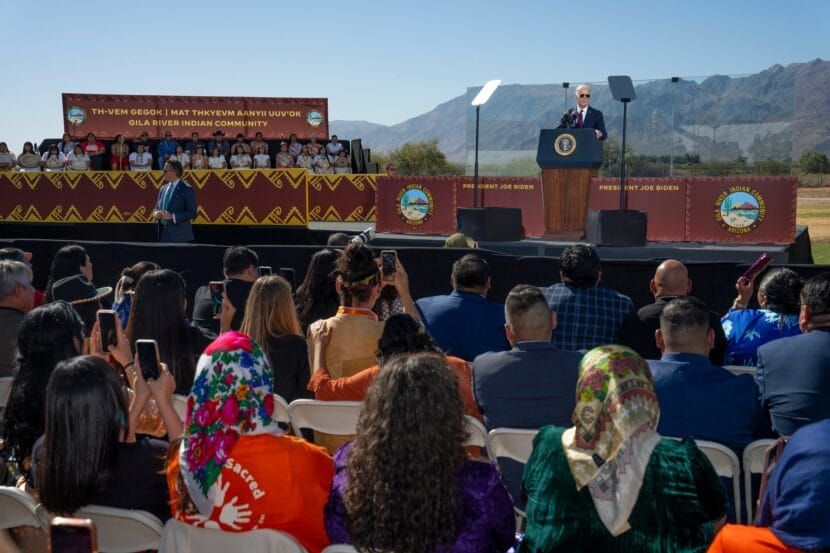
Gila River Indian Reservation, Arizona (October 28, 2024) – President Joe Biden delivered a historic formal apology on behalf of the federal government for its 150-year policy of forcibly placing Native children in Indian Boarding Schools.

“The Federal Indian Boarding School policy and the pain it has caused will always be a significant mark of shame, a blot on American history,” said President Biden in historic remarks. “It’s a sin on our [Nation’s] soul.”

President Joe Biden at Gila River Indian Reservation, Arizona

Picture source: https://x.com/WhiteHouse/status/1849949471888519514/photo/1

“For 150 years, the government attempted to wipe out our Native cultures by removing and relocating thousands of Native children to boarding schools. The President’s historic apology is a painful reminder of this country’s history and our community’s immense resilience,” said Francys Crevier, J.D. (Algonquin), CEO of NCUIH. “Congress needs to act now and pass the Truth and Healing Commission on Indian Boarding Schools Act, and invest in Indian Country, so we can learn from our past and make sure these wrongs are never repeated.”

President Biden’s apology follows the Department of Interior’s (DOI) investigative report, which confirms that at least 973 American Indian, Alaska Native, and Native Hawaiian children died while attending federally operated or supported schools and identifies at least 74 marked and unmarked burial sites at 65 different school grounds. It estimates that the U.S. government appropriated more than $23.3 billion between 1971 and 1969 for the federal Indian boarding school system and other similar institutions and associated assimilation policies (dollars adjusted for inflation based on Fiscal Year 2023).

This act of recognition can foster healing and reconciliation, which are crucial for improving mental and physical health. By validating the experiences of Indigenous peoples and addressing the traumas associated with these institutions, the apology may encourage increased access to health care resources, culturally competent care, and a greater focus on mental health support. Ultimately, such measures can help bridge the gap in health disparities and promote overall well-being within these communities.

NCUIH is particularly grateful to the Native American Boarding School Healing Coalition (NABS) for its unrelenting leadership in securing the DOI’s report and introducing critical legislation in Congress.

Next Steps

Congress must swiftly pass the Truth and Healing Commission on Indian Boarding School Policies in the United States Act (S. 2907/H.R. 5444).

About NCUIH

The National Council of Urban Indian Health (NCUIH) is a national representative advocating for the 41 Urban Indian Organizations contracting with the Indian Health Service under the Indian Health Care Improvement Act. NCUIH is devoted to the support and development of quality, accessible, and culturally competent health and public health services for American Indians and Alaska Natives living in urban areas.

NCUIH respects and supports Tribal sovereignty and the unique government-to-government relationship between our Tribal Nations and the United States. NCUIH works to support those federal laws, policies, and procedures that respect and uplift Tribal sovereignty and the government-to-government relationship. NCUIH does not support any federal law, policy, or procedure that infringes upon or in any way diminishes Tribal sovereignty or the government-to-government relationship.

###

NCUIH Contact: Meredith Raimondi, Vice President of Policy and Communications, mraimondi@ncuih.org

Action Alert: Tell Congress to Reauthorize the Special Diabetes Program for Indians

Contact Congress to Ensure the Special Diabetes Program for Indians is Reauthorized Before December 31, 2024.
We need your help contacting Congress today!

Representative DeGette (D-CO-01) and Representative Bilirakis (R-FL-12) are leading a letter to House leadership in support of reauthorizing the Special Diabetes Program for Indians (SDPI) prior to its expiration at the end of December.

Why is SDPI important?

  • SDPI supports research-based interventions for diabetes prevention and cardiovascular disease risk reduction in American Indian and Alaska Native community-based programs and healthcare settings.
  • SDPI serves 780,000 American Indian and Alaska Native people across 302 programs in 35 states.
  • Currently, 31 urban Indian organizations (UIOs) receive SDPI funding that enables UIOs to provide necessary services that reduce the incidence of diabetes-related illness among urban Indian communities.
  • SDPI’s integrated approach to diabetes healthcare and prevention programs in Indian Country has become a resounding success and is one of the most successful public health programs ever implemented.

Why is this urgent? 

  • Funding for SDPI expires on December 31, 2024.
  • As Congress heads into the end of the 118th Congress, the top priority is finalizing and passing an omnibus funding bill for Fiscal Year 2025. This is the best opportunity for reauthorizing SDPI before it expires at the end of December 2024.

To ensure that SDPI receives as much support as possible, we encourage you to contact your member of congress to support reauthorization of SDPI. Please find a template email below with instructions. Thank you for your leadership. Your outreach on this is invaluable to providing greater health equity for American Indian and Alaska Native people.

Sincerely,
The National Council of Urban Indian Health

Ways to Advocate

Contact Congress!

Step 1: Copy the email below.
Step 2: Find your Representative here.
Step 3: Go to their website and click contact.
Step 4: Paste the email into the form and send. Please contact Meredith Raimondi (policy@ncuih.org) with questions.

Email to Your Representative!

Dear Representative [NAME],

As an urban Indian health advocate, I respectfully request you sign on to the DeGette-Bilirakis letter to House Leadership in support of reauthorizing the Special Diabetes Program for Indians (SDPI) prior to its expiration on December 31, 2024.

SDPI supports research-based interventions for diabetes prevention and cardiovascular disease risk reduction in American Indian and Alaska Native community-based programs and healthcare settings, including 31 Urban Indian Organizations. SDPI’s integrated approach to diabetes healthcare and prevention programs in Indian Country has become a resounding success and is one of the most successful public health programs ever implemented.

As Congress works on final appropriations for Fiscal Year 2025, this is a critical moment to take a significant step towards fulfilling the trust responsibility to ensure healthcare access for American Indian and Alaska Native people. The highly successful, bipartisan program is a proven success, and reauthorization should be a top priority for Congress.  Your support in signing this letter will be instrumental in achieving this goal.

You can sign on to the letter by contacting David Steury (David.steury@mail.house.gov) or Chris Jones (Chris.Jones@mail.house.gov).

Thank you for your leadership and your commitment to Indian Country.

Sincerely,
[NAME]

NCUIH respects and supports Tribal sovereignty and the unique government-to-government relationship between our Tribal Nations and the United States. NCUIH works to support those federal laws, policies, and procedures that respect and uplift Tribal sovereignty and the government-to-government relationship. NCUIH does not support any federal law, policy, or procedure that infringes upon, or in any way diminishes, Tribal sovereignty or the government-to-government relationship.

NCUIH Contact:Meredith Raimondi, Vice President of Policy and Communications, mraimondi@ncuih.org

PRESS RELEASE: NCUIH Celebrates CMS Approval of Medicaid Coverage for Traditional Healing Services, Emphasizes Importance for Urban Indian Organizations

FOR IMMEDIATE RELEASE

“This approval is a testament to the tireless advocacy of Tribal leaders, Urban Indian Organizations, and our partners,” said Francys Crevier, J.D. (Algonquin), CEO of NCUIH. “It marks a historic milestone in our ongoing efforts to ensure that American Indian and Alaska Native people in urban areas have access to culturally appropriate, holistic care that honors our Traditional Healing practices”.

“As we’ve long advocated, the ability to provide and be reimbursed for culturally relevant services offers a greater opportunity to deliver whole-person care,” Crevier added. “This CMS approval is a crucial step towards health equity and honoring the rich traditions of our diverse Native communities, including those in urban areas”.

– NCUIH CEO, Francys Crevier (Algonquin)

Washington, D.C. (October 18, 2024) – The National Council of Urban Indian Health (NCUIH) enthusiastically welcomes Wednesday’s announcement by the Centers for Medicare & Medicaid Services (CMS) approving Medicaid coverage for Traditional Healing services in four states: California, Arizona, New Mexico, and Oregon.

This landmark decision represents a significant step forward in recognizing the value of culturally-based traditional health care practices for American Indian and Alaska Native people, including those living in urban areas.

Urban Indian Organizations and State-Specific Waivers

While the CMS approval is a significant step forward, it’s important to note that the implementation and coverage for Urban Indian Organizations (UIOs) varies by state:

  1. Arizona (AHCCCS):  Traditional Healing is covered for IHS and Tribal facilities. UIOs are not explicitly included as covered facilities. However, Traditional health care practitioners or providers at UIOs contracting with an IHS or Tribal facility could be included.
  2. California (CalAIM): California will have expenditure authority to provide coverage for traditional health care practices received through IHS, Tribal, or UIO facilities by Medicaid and CHIP beneficiaries who are able to receive services delivered by or through these facilities. The state will initially provide this coverage only to beneficiaries eligible to participate in the Drug Medi-Cal Organized Delivery system. However, California will have authority to expand coverage to all Medicaid beneficiaries who receive services delivered by or through an IHS, Tribal, or UIO facility.
  3. New Mexico (Turquoise Care): The state will have expenditure authority to provide coverage for Traditional Healing practices received through IHS, Tribes, or UIO facilities.
  4. Oregon (OHP): Traditional health care practices received through IHS, Tribal, or UIO facilities will be covered when provided to a Medicaid or CHIP beneficiary who is able to receive services delivered by or through these qualifying providers. State expenditures for Traditional Healing delivered at UIOs will receive the applicable state service match.

Next Steps

NCUIH will continue to work closely with CMS, state Medicaid programs, and UIOs to ensure smooth implementation of this new coverage and to advocate for equitable inclusion of UIOs in all states.


About NCUIH

The National Council of Urban Indian Health (NCUIH) is a national representative advocating for the 41 Urban Indian Organizations contracting with the Indian Health Service under the Indian Health Care Improvement Act. NCUIH is devoted to the support and development of quality, accessible, and culturally competent health and public health services for American Indians and Alaska Natives living in urban areas.

NCUIH respects and supports Tribal sovereignty and the unique government-to-government relationship between our Tribal Nations and the United States. NCUIH works to support those federal laws, policies, and procedures that respect and uplift Tribal sovereignty and the government-to-government relationship. NCUIH does not support any federal law, policy, or procedure that infringes upon or in any way diminishes Tribal sovereignty or the government-to-government relationship.

###

NCUIH Contact: Meredith Raimondi, Vice President of Policy and Communications, mraimondi@ncuih.org

Stay Informed: NCUIH Launches Updated Regulations Tracker for Indian Health Advocacy

The National Council of Urban Indian Health (NCUIH) recently published an updated regulations tracker (https://ncuih.org/policy/regulation-tracker/) on NCUIH’s website (https://ncuih.org/). The tracker includes relevant regulations and other agency actions that impact Urban Indian Organizations (UIOs) or the health of American Indian and Alaska Native people living in urban areas. It contains information from the Federal Register (https://www.federalregister.gov/), Dear Urban Indian Organization Leader Letters (DULLs), Dear Tribal Leader Letters (DTLLs), and other publications that may be helpful to UIO leaders and other advocates for American Indian and Alaska Native health. The tracker is updated on an ongoing basis.

NCUIH Urges HHS to Collaborate with Urban Indian Organizations and Tribes on Syphilis and Congenital Syphilis Education, Stigma Reduction, and Data Sharing

On September 4, 2024, the National Council of Urban Indian Health (NCUIH) submitted written comments to the U.S. Department of Health and Human Services (HHS) Assistant Secretary for Health, Admiral Rachel L. Levine, in response to the HHS Office of the Assistant Secretary for Health (OASH) July 2, 2024, Dear Tribal Leader Letter (DTLL). In its comments, NCUIH requested that HHS and the National Syphilis and Congenital Syphilis Syndemic Federal Task Force (Task Force) partner with urban Indian organization (UIOs) to reduce stigma and increase education on syphilis and congenital syphilis and facilitate dissemination of timely data on syphilis and congenital syphilis to Tribes and UIOs.

Background

Disproportionate Impact of Syphilis on American Indian and Alaska Native Communities

The rates of primary and secondary syphilis have risen every year since 2001. Congenital syphilis rates have also risen. Racial and ethnic minorities, including American Indian and Alaska Native people, have been disproportionately affected by the surge of cases. According to the Centers for Disease Control and Prevention’s National Center for HIV, Viral Hepatitis, STD, and TB Prevention, American Indian and Alaska Native people experience the greatest relative disparity in primary and secondary syphilis cases, representing “2.8% of reported P&S syphilis cases . . . despite being 0.7% of the US population, or a burden 4.0 times what would be expected based on their proportion of the population.” American Indian and Alaska Native mothers also experienced the greatest relative disparity in congenital syphilis cases, representing “4.6% of reported congenital syphilis cases . . . despite being 0.7% of live births, or a burden 6.6 times what would be expected based on their proportion of live births.”

HHS Task Force: A Collaborative Response to Rising Syphilis Cases

HHS established the Task Force as part of the agency’s commitment to addressing these escalating cases. The Task Force is a cross-agency collaborative effort, with participants from HHS agencies and offices, including the Indian Health Service (IHS), as well as the Department of Agriculture, Department of Justice, Department of Veterans Affairs, and the White House, including both the Office of National Drug Control Policy and the Office of National AIDS Policy.

The Task Force identified 14 priority jurisdictions that account for nearly 75 percent of congenital syphilis cases and over 55 percent of primary and secondary syphilis cases nationwide to focus on targeted interventions. Additionally, these 14 priority jurisdictions represent over 65 percent of primary and secondary syphilis and over 70 percent of congenital syphilis cases among individuals that identify as American Indian and Alaska Native. 21 UIOs serve American Indian and Alaska Native patients in 8 of the 14 priority jurisdictions.

NCUIH’s Requests

In its comments, NCUIH recommended:

  • HHS and the Task Force must work with UIOs as part of their strategy to reduce the cases of syphilis and congenital syphilis in American Indian and Alaska Native communities
    • HHS and the Task Force should Host Urban Confers or UIO listening sessions and continue to seek Tribal feedback
    • HHS and the Task Force should partner with UIOs to reduce stigma and increase education on syphilis and congenital syphilis
  • HHS and the Task Force should facilitate dissemination of timely data on syphilis and congenital syphilis to Tribes and UIOs

NCUIH will continue to monitor as OASH addresses the syphilis and congenital syndemic impacting American Indian and Alaska Native people.

PRESS RELEASE: NCUIH Releases Financing Toolkit for Providers to Address Behavioral Health Disparities in American Indian and Alaska Native Communities

FOR IMMEDIATE RELEASE

WASHINGTON, D.C. (October 9, 2024) – The National Council of Urban Indian Health (NCUIH) has released a new resource to combat the significant mental health challenges facing American Indian and Alaska Native (AI/AN) communities. The toolkit, Investing in Wellness: Financing Strategies for Behavioral Health in Indian Country, developed in response to the alarming statistic that 19 percent of AI/AN individuals reported experiencing a mental illness in the past year, seeks to provide sustainable funding solutions and resources to enhance behavioral health care access in Indian Country.

The toolkit comes at a time when behavioral health issues among AI/AN communities have not received equal policy attention or funding. Existing funding models often rely on short-term grants that inadequately address the persistent and complex needs of these communities. “The Investing in Wellness toolkit is essential for bridging the funding gap in behavioral health services,” said NCIUH CEO Francys Crevier, J.D. (Algonquin). “We aim to equip leaders with practical financing strategies tailored specifically for American Indian and Alaska Native health care systems, ultimately improving access to prevention, treatment, and recovery services. By focusing on the patient journey and incorporating traditional healing practices into behavioral health programming, the toolkit aligns with the growing advocacy for holistic approaches in treatment.”

Key strategies outlined in the toolkit include:

  • Enhancing Behavioral Health Care Access Through Optimizing Medicaid Reimbursement
  • Traditional Healing as a Financially Sustainable Strategy for Improving Behavioral Health
  • Cultivating Funding Opportunities for Behavioral Health Programming
  • Investing in Prevention, Crisis Care, and Integrated Services
  • Strategies to Build, Expand, and Sustain Behavioral Health

The development of this toolkit was guided by a community-based participatory approach, ensuring that the needs and voices of AI/AN communities were central to its creation. “Culturally sensitive care is an important part of any treatment regimen. The Investing in Wellness toolkit notably supports traditional healing practices, such as therapeutic talking circles and natural remedies, as proven ways to support person-centered health and wellness,” said Alaina McBournie, senior manager for the substance use prevention and treatment initiative at The Pew Charitable Trusts. “Pew is proud to partner with NCUIH to help expand access to lifesaving services for American Indian and Alaska Native people.”

View Toolkit

About NCUIH

The National Council of Urban Indian Health is a national non-profit organization devoted to the support and development of quality, accessible, and culturally competent health and public health services for American Indian and Alaska Native people living in urban areas. NCUIH advocates for the 41 Title V Urban Indian Organizations under the Indian Health Service in the Indian Health Care Improvement Act.

NCUIH respects and supports Tribal sovereignty and the unique government-to-government relationship between our Tribal Nations and the United States. NCUIH works to support those federal laws, policies, and procedures that respect and uplift Tribal sovereignty and the government-to-government relationship. NCUIH does not support any federal law, policy, or procedure that infringes upon or in any way diminishes Tribal sovereignty or the government-to-government relationship.

###

NCUIH Contact: Meredith Raimondi, Vice President of Policy and Communications, mraimondi@ncuih.org, 202-417-7781

NCUIH Supports Native Community and Voter Engagement at Native Health’s National Voter Registration Day Event in Phoenix

On September 19, 2024, Native Health in Pheonix, Arizona hosted Frybread for the Future Fest, an event focused on building community and registering Arizona residents to vote. Over 500 people were in attendance and approximately 30 eligible voters registered to vote. During the event, which was hosted at the site of the former Phoenix Indian Boarding School, participants were able to check their voter registration, browse an Indigenous Market, speak with staff from Native Health and Inter-Tribal Council of Arizona, get free Native Vote swag, and enjoy homemade frybread and ice cream. The event also had traditional performances by local Tribal members. Native Health hosts hundreds of similar events each year, which play an important role in building community and provide a space for community members to stay connected to traditional cultural practices.

NCUIH staff, Chelsea Guitierrez and Emily Larsen

NCUIH staff, Chelsea Guitierrez and Emily Larsen, provided support for the event, assisting in set-up, handing out t-shirts, and clean up.

Native Health Designated as First IHS Voter Registration Site

On March 5, 2023, President Biden announced agency actions to make the voting process more accessible in alignment with recommendations made by the Native American Rights Fund (NARF). This included a new initiative at the Indian Health Service (IHS) piloting “high-quality voter registration services across five different IHS facilities before the end of 2023”. The first facility to be announced under this pilot program was Native Health.

NCUIH Advocacy on Voting Efforts

In partnership with the National Urban Indian Family Council (NUIFC), NCUIH has been working with UIOs, like Native Health, to Get Out The Vote and increase Native voter participation in the 2024 election cycle. Voter information, including a social media toolkit can be found here.

NCUIH Requests IHS Support All Facility Types and Integrate Social Services into the New IHS Electronic Health Record System

On September 6, 2024, the National Council of Urban Indian Health (NCUIH) submitted written comments to the Indian Health Service (IHS) Director, Roselyn Tso, regarding the IHS’ January 18, 2024, Dear Tribal Leader and Urban Indian Organization Leader letter (DTLL/DULL) about the August 8, 2024, joint Tribal Consultation and Urban Confer (TC/UC) session on Health Information Technology (HIT) Modernization: Multi-Tenant Domain Considerations. In its comments, NCUIH requested that IHS support all facility types to address inefficiencies during the implementation process and ensure social services are integrated into IHS’ new electronic health record (EHR) system.

Background on IHS HIT Modernization

During the November 8, 2023, TC/UC on HIT Modernization, IHS announced that it selected General Dynamics Information Technology, Inc. (GDIT) to build, configure, and maintain a new IHS enterprise EHR system utilizing Oracle Cerner technology. The new EHR, named Patients at the Heart (PATH), will replace the Resource and Patient Management System (RPMS).

For more information about HIT Modernization implementation, please click here.

NCUIH’s Requests

In its comments following the TC/UC, NCUIH recommended:

  • IHS should increase the value proposition for urban Indian organizations (UIOs) to participate in the PATH EHR:
    • Integrate social services into the PATH EHR
    • Support the unique interoperability needs of UIOs
    • Ensure security of patient health information
  • IHS should address the following challenges and risks that UIOs may face when transitioning from their current EHRs to the shared PATH EHR:
    • Lack of support for all UIO facility types
    • Failure to be included in pilot site and implementation cohort selection

NCUIH Advocacy on HIT Modernization

NCUIH has previously submitted several comments to IHS on HIT Modernization:

NCUIH also submitted written testimony  to the House Appropriations Subcommittee on Labor, Health and Human Services, Education, and Related Agencies regarding the Fiscal year (FY) 2024 funding for UIOs in which NCUIH requested increased funding for EHR Modernization. Specifically, NCUIH requested support for the IHS’ transition to a new EHR system for IHS and UIOs by supporting the President’s budget request of $913 million in FY 2024 appropriations.

NCUIH will continue to closely follow IHS’s progress and policies with HIT Modernization.

FAQ on TEFCA for Urban Indian Organizations

1. What is TEFCA?

  • TEFCA was created by the Department of Health and Human Services (HHS) Assistant Secretary for Technology Policy/Office of the National Coordinator for Health Information Technology (ASTP/ONC) under the authority of the 21st Century Cures Act.
  •  The goals of TEFCA are:
    1. (1) to establish a universal governance, policy, and technical floor for nationwide interoperability;
    2. (2) to simplify connectivity for organizations to securely exchange information to improve patient care, enhance the welfare of populations, and generate health care value; and
    3. (3) to enable individuals to gather their health care information.
  • TEFCA is made up of two parts:
    • (1) The Trusted Exchange Framework (TEF), a set of principles to follow when participating in secure data exchange under TEFCA.
    • (2) The Common Agreement (CA), a standardized agreement that enables data sharing between TEFCA participants.
  • Combined, they are referred to as the “TEFCA,” which supports a nationwide exchange of Electronic Health Information (EHI) across disparate Health Information Networks (HINs). HINs are entities that serve as a network for health information across health care entities, electronic health record platforms, and other entities that store and share electronic health information.

2. What entities are involved in TEFCA?

  • The entities involved in TEFCA are:
    • The HHS Assistant Secretary for Technology Policy/Office of the National Coordinator for Health Information Technology (ASTP/ONC): the federal agency responsible for implementing TEFCA.
    • The Recognized Coordinating Entity (RCE): the entity responsible for the development, implementation, and maintenance of the Common Agreement and for the review of applications from HINs seeking to join TEFCA and become QHINs.
    • Qualified Health Information Network (QHIN): an HIN that has completed the application and onboarding process required by the RCE and is now “qualified” to share information within the TEFCA framework.
      • QHINs currently part of TEFCA include eHealth Exchange, Epic Nexus, Health Gorilla, KONZA, MedAllies, CommonWell Health Alliance, and Kno2.
    • Participants: persons or entities who are contracted with a QHIN and have agreed to participate in TEFCA under the Common Agreement. Participants can include health information networks; health information exchanges; individuals; providers; federal agencies; public health agencies; health plans and other payers; and health IT developers (e.g., electronic health records systems).
    • Subparticipants: persons or entities who use services provided by a Participant through sending and receiving Electronic Health Information. Subparticipants are often healthcare providers, health systems, ambulatory providers, and health IT developers.
    • Principal: a QHIN, Participant, or Subparticipant that is acting as a Covered Entity, Government Health Care Entity, Non-HIPAA Entity (NHE) Health Care Provider, a Public Health Authority, a government agency that makes a Government Benefits Determination, or an Individual Access Services Provider.
    • Delegate: a QHIN, Participant, or Subparticipant that has a written agreement, directly or indirectly, with a Principal authorizing the Delegate to conduct TEFCA Exchange activities for or on behalf of the Principal.

3. What role do UIOs play in TEFCA?

  • Under the TEFCA framework, a UIO whose EHR provider has contracted with a QHIN is considered a “Subparticipant.” The UIO’s EHR provider is a “Participant.”
  • In some cases, a UIO’s EHR provider may choose to become a QHIN and join TEFCA. This would then label any UIO that join TEFCA through this provider a “Participant.”
  • Additionally, a UIO can join TEFCA under any QHIN of their choosing and become a “Participant.” It does not have to be done through their EHR system.

4. How do UIOs become Participants/Subparticipants in TEFCA?

  • Each QHIN must agree to the terms of the Common Agreement.
  • The Common Agreement contains Terms of Participation which must be signed by each Participant and Subparticipant. These have also been referred to as “flowdown provisions.”
  • For example, if the EHR system a UIO uses is connected to an HIN that completes the process to become a QHIN under TEFCA, and the UIO’s EHR system then agrees to the terms of the ToP and becomes a Participant under TEFCA, then the UIO may have the option to sign the ToP to become a Subparticipant under TEFCA.
  • The signing of the ToP is also required if a UIO joins as a Participant under an EHR system that is acting as a QHIN, or directly through any QHIN currently part of TEFCA.
  • Signature of the ToP is only required if a UIO wants to join TEFCA’s nationwide health information exchange. UIOs are not required to join TEFCA, even if their EHR becomes a Participant in TEFCA or joins TEFCA as a QHIN.
  • If UIOs do not sign the ToP, they can still utilize health information technology, like the EHR system, but will not be able to participate in nationwide health information exchange through TEFCA.
  • If the EHR a UIO uses has joined a QHIN as a Participant, but the UIO has not been given the option to join the QHIN as a Subparticipant, it is recommended that the UIO reach out to their EHR for more information. UIOs can also reach out to QHINs directly for information about joining TEFCA.
  • Today, participation is voluntary, allowing UIOs flexibility to make the decision to join TEFCA. However, if any UIOs signed a previous sub-agreement to join TEFCA before July 1, 2024, they must agree to the updated ToP by December 27, 2024, to continue to participate in TEFCA.

5. How does health information exchange work under TEFCA?

  • Requests are made through QHIN-to-QHIN exchange and must be for one or more of the reasons outlined in the Exchange Purposes (XPs) and must follow the requirements outlined in the XP Standard Operating Procedure (SOP). These purposes include treatment, payment, health care operations, public health, government benefits determination, and individual access services (IAS).
  • For example, a UIO (as a Participant or Subparticipant) may initiate a QHIN Query to supplement or update a patient’s records they maintain. The UIO, now acting as a Principal, would request the Delegate contact their QHIN to initiate the query, under the specified XP code, to other QHINs who may be connected to entities (either a Participant or Subparticipant) that may have records for that patient. These entities could include a state health department, tribally operated hospital, or any facility that has been connected to TEFCA through their own QHIN.
  • The technical infrastructure that supports exchange of information is maintained by QHINs. Data is not stored by the QHIN, it is only exchanged between the two entities. Neither Participants nor Subparticipants actively participate in the process. Participants and Subparticipants only make requests or respond to requests made by other TEFCA entities.

6. Is TEFCA currently in effect?

  • Yes, TEFCA has been live since the fourth quarter of 2023 when the first QHINs went live with health information exchange.

7. Are there any anticipated changes to TEFCA?

  • TEFCA will continue to evolve, and we can anticipate changes in participation, exchange purposes, governance and documentation moving forward. Additional QHINs are already in the process of being approved.
  • Documents are still being updated to assist with implementation of TEFCA. The most recent updates were
    July 1, 2024, and August 6, 2024, but more updates will be provided later this fall. These updates can be found on the Sequoia Project’s website.
  •  In addition, the Sequoia Project holds webinars to provide an overview of updates, which includes a Q&A session for any potential questions.

September Policy Updates: Election Resources, FY25 Appropriations, Legal Developments, and More!

💵 Area Budget Formulation on the Horizon: Your engagement in the FY27 Budget Formulation Cycle is crucial.

🗳Election 2024: State-specific graphics now available to boost voter participation in the 2024 election.

💰 Appropriations Update: Updates on FY25 funding and the potential for a Continuing Resolution to prevent a government shutdown.

📝 Federal Comments: Review NCUIH’s recent recommendations to federal agencies on Medicaid, HIT Modernization, and syphilis outbreak response. Share your input on the USDA Dietary Guidelines by October 1.

🏛 Legislative Updates: Updates on FMAP, SDPI reauthorization, Telehealth Modernization Act, and BADGES for Native Communities Act.

🔙 ICYMI: Stay informed with the latest Dear Tribal Leader Letters and Federal Tribal Advisory Committee Meetings

🚀 NCUIH in Action: Highlights from the VAWA celebration at the White House with President Biden, National Voter Registration Day at Native Health Phoenix and, and engagement with Members of Congress.

📅 Important Dates: Mark your calendars for upcoming meetings and events.

Legal Update: Monitoring the Becerra v. San Carlos Apache case as IHS develops new contract support costs methodology.

On the Horizon: Area Budget Formulation – Your Engagement Matters!
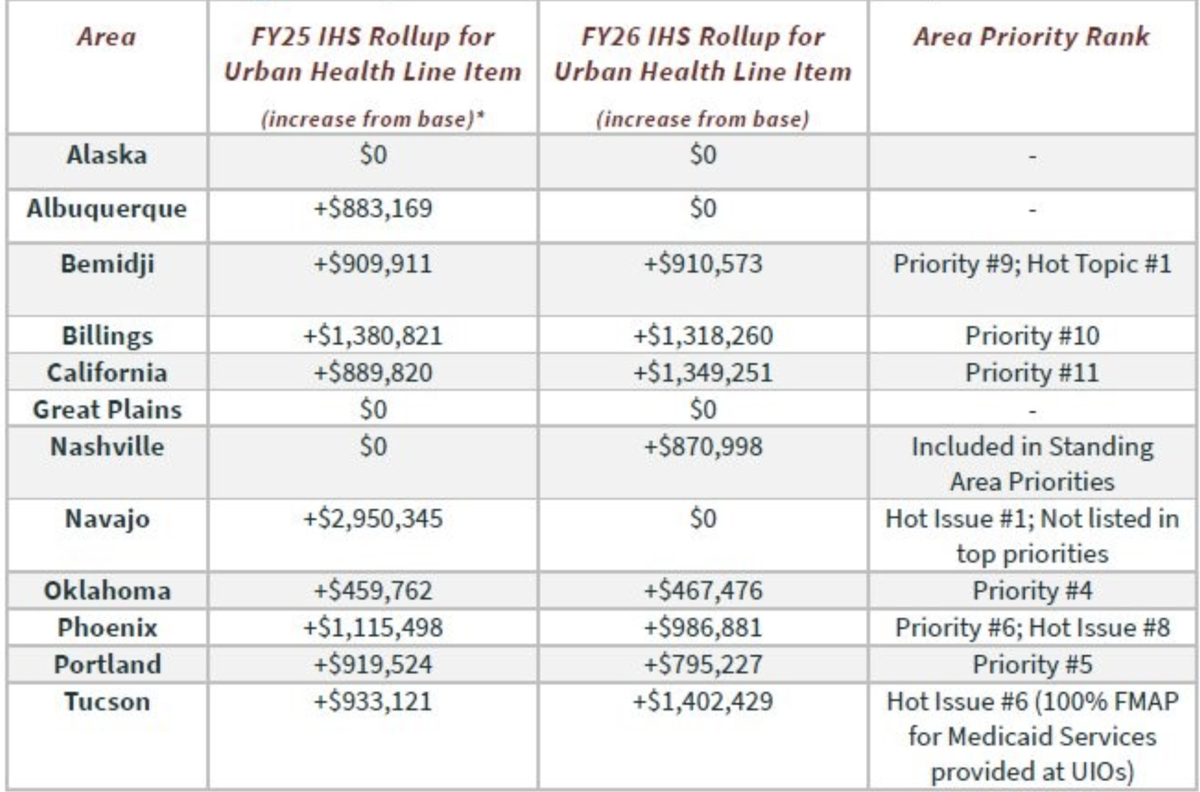
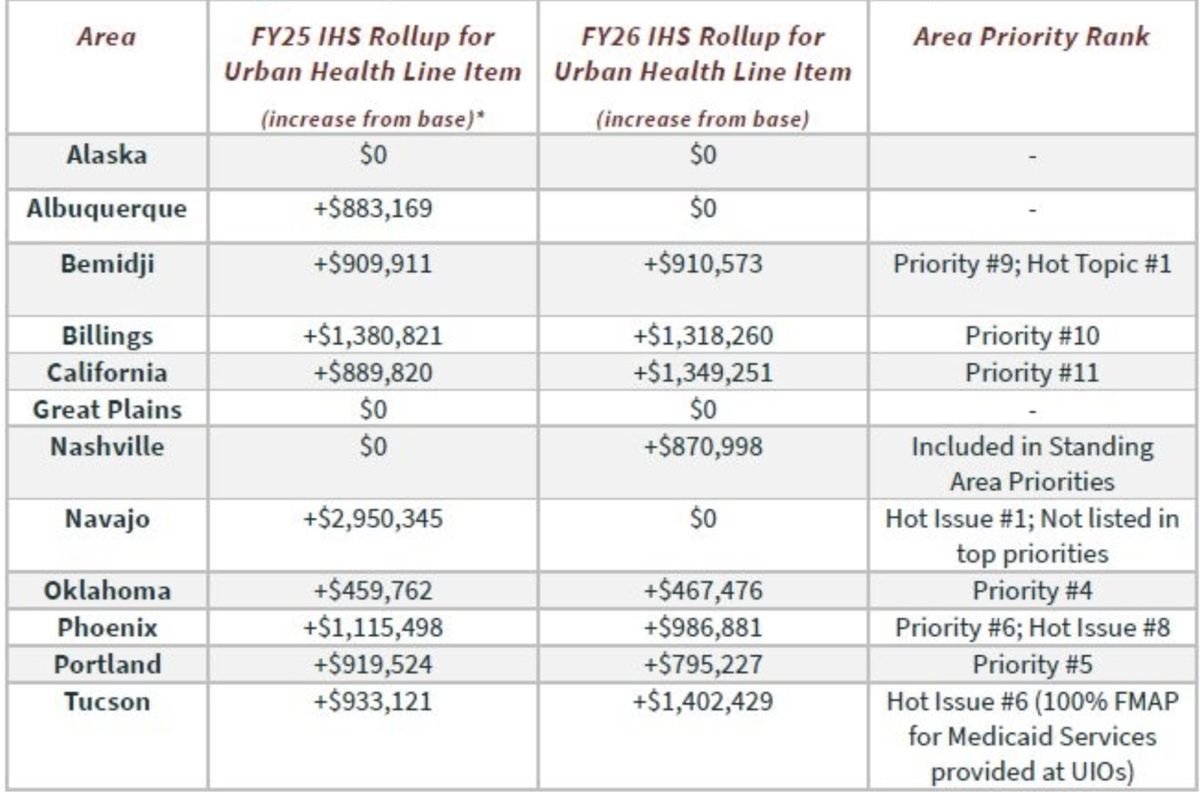
IHS is beginning the FY27 Budget Formulation Cycle and UIOs are invited by their Area Offices to participate in this important opportunity to impact the budget recommendations for your area.

  • Why is UIO engagement important?: UIO input in Area Budget Formulation meetings can drastically influence budget requests for the urban line item and priority areas.
  • Go Deeper: It is critically important that UIOs attend their Area Budget Formulation meeting and advocate for additional support for urban Native communities.
  • Last Year: A number of areas prioritized funds for the Urban line item to help UIOs as seen in the chart above.
  • Date Anticipation: FY 2026 Area Budget Consultations set to begin in October, 2024

Empowering Native Votes: State-Specific Graphics Now Available for UIOs

Introducing the new Urban Voices Amplified: Empowering Native Votes Toolkit, developed by the NCUIH with support from the National Urban Indian Family Coalition. This resource is designed to provide Urban Indian Organizations with crucial voter information, helping American Indian and Alaska Native communities stay informed about important deadlines for the 2024 election.

Toolkit Highlights: 

  • State-specific graphics, including key voter registration deadlines and election dates.
  • Resources to help individuals register or update their voter information.

Access the Toolkit: Download the Toolkit and share it with your community to support voter participation.

Appropriations Updates

Fiscal Year 2025:

On Wednesday, September 25, Congress passed a Continuing Resolution, or short-term government funding bill, which would fund the government until Dec. 20, and prevent a government shutdown.

  • The bill does not include the controversial SAVE Act, a GOP measure that requires voters to show proof of citizenship.

FY 2025 Funding for Veterans:

On Thursday, September 19, 2024, Congress passed supplemental funding bill (HR 9468) to address the close to $3 billion budget shortfall for Veteran’s benefits.

  • This funding ensures that all veterans will continue to receive their pension and benefits without lapse.
  • There are no Native specific programs in this bill.

Take Action to Support Mandatory Funding for IHS CSCs and 105(l) leases: 

NCUIH sent out an action alert urging advocates to contact Congress to support mandatory funding for IHS Contract Support Costs (CSCs) and 105(l) lease funding.

  • Ways to advocate: Call or email your Representative, and post on social media using the template language provided in the action alert. Contact Congress.
  • Why Participate: Shifting these costs to mandatory funding is important to avoid   funding impacts for other IHS programs and will enable true increases in funding for essential services.

NCUIH Provides Key Recommendations on Medicaid, Health IT Modernization, and Syphilis Outbreak Response to Federal Agencies

On September 9, NCUIH submitted comments to the Centers for Medicare and Medicaid Services (CMS) on its Outpatient Prospective Payment System (OPPS) Proposed Rule, specifically regarding Medicaid clinic services four walls exceptions and All-Inclusive Rate add-on payment for high-cost drugs provided by IHS and Tribal outpatient facilities.

On September 6, NCUIH submitted comments to IHS in response its joint Tribal Consultation and Urban Confer on Health IT (HIT) modernization multi-tenant domain considerations

  • Go deeper: NCUIH recommended that IHS support the unique interoperability needs of UIOs and ensure security of patient health information. NCUIH also recommended that IHS address the challenges and risks that UIOs may face when transitioning EHRs.

On September 5, NCUIH submitted comments to HHS Office of the Assistant Secretary for Health (OASH) regarding the syphilis and congenital syphilis outbreak in Indian Country.

  • Go deeper: NCUIH recommended that HHS and the National Syphilis and Congenital Syphilis Syndemic Federal Task Force work with UIOs as part of their strategy and continue to seek Tribal feedback.

Upcoming Federal Agency Comment Opportunity

October 1 – United States Department of Agriculture (USDA) Dietary Guidelines for America

  • USDA is seeking public comment as the 2025 Dietary Guidelines Advisory Committee conducts its scientific review process. Learn more here.

Legislative Updates: 100% FMAP for UIOs, SDPI, Telehealth Modernization, and MMIP

Recent update on 100% Federal Medical Assistance Percentage (FMAP) for UIO Medicaid Services: 

Next Steps:

  • NCUIH remains focused on having the Urban Indian Health Parity Act (H.R. 6533) included in any lame duck legislation (the period between the November election and the start of the new Congress).

What UIOs Can Do:

  • If UIOs would like to write a letter or meet with their Member of Congress to support this legislation, NCUIH is available to assist. Email policy@ncuih.org.
  • We also are looking for Tribal letters of support. Please reach out to policy@ncuih.org if you know of any Tribes that would be willing to send a letter.

Special Diabetes Program for Indians (SDPI) Update

The Special Diabetes Program for Indians was reauthorized in the March 2024 Consolidated Appropriations Act through December 31, 2024. The total funding for the 2024 calendar year was $158 million, which marked the first increase for the program since 2002. Congress must pass legislation to reauthorize and appropriate funding for the program for it to continue into FY 2025 and beyond.

NCUIH continues to advocate to Congressional leadership to ensure reauthorization of this critical program in any end of year funding package.

What UIOs Can Do:

  • If UIOs would like to write a letter or meet with their Member of Congress to support this program, NCUIH is available to assist. Email policy@ncuih.org.

Telehealth Modernization Act (H.R. 7623)

On September 18, 2024, the Energy and Commerce full committee passed out of markup the Telehealth Modernization Act of 2024 (H.R. 7623).

  • This bill permanently extends telehealth flexibilities for Medicare beneficiaries and extends these flexibilities to federally qualified health centers and rural health clinics.
  • The bill awaits further passage in the House and has not received any action in the Senate.

BADGES for Native Communities Act (S. 465)

On September 25, 2024, the Senate Committee on Indian Affairs passed out of committee the Bridging Agency Data Gaps and Ensuring Safety (BADGES) for Native Communities Act.

  • This bill requires law enforcement agencies to report on cases of missing or murdered Native people.
  • The bill now awaits further consideration from the Senate.

Recent Tribal Leader Letters and Dear Urban Leader Letters, Federal Tribal Advisory Committee Meetings

Recent Dear Tribal and Urban Leader Letters (DTLL/DULL)

September 10 DTLLIHS Tribal Consultation on Contract Support Costs (CSC) Methodology for Program Income

  • IHS is initiating Tribal Consultation to seek and obtain Tribes’ recommendations on funding methodologies for the payment of eligible CSCs incurred by Tribes and Tribal Organizations related to expenditures of program income.
  • There will be a total of five Tribal consultation sessions in September and October. Future Sessions:
    • – IN PERSON: Tuesday, October 1, 2024, from 9:30 a.m. – 12:30 p.m. ET in Washington D.C. Register here.
    • – IN PERSON: Thursday October 3, 2024, from 9:30 a.m. – 12:30 p.m. PT in Seattle, Washington. Register here.
    • – VIRTUAL: Wednesday, October 9, 2024, form 1:00 p.m. – 5:00 p.m. ET Register here.
  • Written comments are due by October 11, 2024, and can be emailed to consultation@ihs.gov with the subject line: CSC Methodology for Program Income.
  • This letter also provides an update on the Agency’s ongoing efforts that the IHS has taken to implement the United States Supreme Court’s decision in Becerra v. San Carlos Apache Tribe.

September 4 DTLLHHS Tribal Data Access Policy Consultation

  • HHS is hosting Tribal Consultation on the Draft HHS Tribal Epidemiology Center Data Access Policy and Draft HHS Tribal Data Access Policy, to provide updates on the policies, and make them aware that the Tribal Data Access Website is now live.
  • Tribal Consultation will take place Tuesday, October 1, 2024, 3:00 p.m.-5:00 p.m. ET via Zoom. Register here.
  • Written comments are due by October 31, 2024, and can be emailed to consultation@hhs.gov with the subject line (please separate your comments by each draft): HHS Tribal Data Access Policy or HHS TEC Data Access Policy.

Important Events

At the Tribal Leaders Diabetes Committee (TLDC) meeting: NCUIH Senior Policy Analyst Carolyn Kowalyk, staffed NCUIH Board Treasurer Adrianne Maddux, who serves as NCUIH’s Technical Advisor for TLDC.

September 17-18: IHS Tribal Leaders Diabetes Committee (TLDC) Quarterly Meeting in Washington, D.C.

  • What was said: A discussion was held on how to disperse the rest of the $43 million of SDPI unobligated funds. The Committee agreed that an “administrative” supplement for eligible programs over the next two years would be ideal. IHS announced that there will be a comment period on this decision when a DTLL/DULL is released at the end of September.
  • What’s next: A Tribal Consultation and Urban Confer will be held this fall and the comments will be compiled and presented at the next quarterly TLDC meeting in December.

September 10-12: HHS Secretary’s Tribal Advisory Committee (STAC) Meeting

  • What was said: HHS submitted its proposed FY26 budget to Office of Management and Budget (OMB). FY26 Budget planning is now paused, HHS will adjust for new the administration.
  • HHS is taking steps to carry out Executive Order (EO) 14112: Reforming Federal Funding and Support for Tribal Nations. HHS is awaiting OMB to issue a funding needs assessment to guide the agency in ensuring federal notice of funding opportunities are developed in a manner consistent with EO 14112.
  • CMS is actively working on approving Medicaid demonstration requests for Traditional Healing reimbursement from four states (AZ, CA, OR, NM). CMS anticipates positive news soon.

NCUIH in Action

NCUIH CEO Francys Crevier (Algonquin) and Indian Health Center of Santa Clara Valley CEO and Chair of the Health Subcommittee for the VA Advisory Committee on Tribal and Indian Affairs Sonya Tetnowski (Makah).

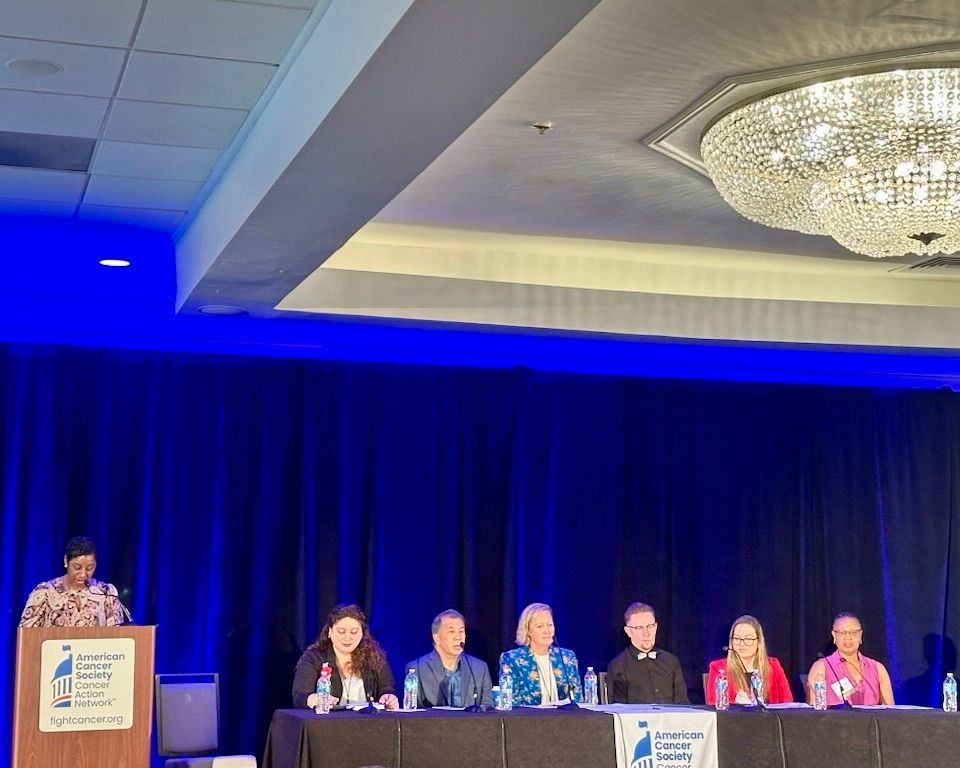
On September 24, NCUIH CEO Francys Crevier (Algonquin) presented on the Veteran Affairs Advisory Committee on Tribal and Indian Affairs Panel, emphasizing the urgent need to address the health disparities faced by urban Native veterans. She called for improved housing resources, better care coordination between UIOs and the VA, and expanded technical assistance for Urban Indian Organizations. Crevier also acknowledged the critical leadership of Sonya Tetnowski, Army Veteran and former NCUIH Board President, who continues to champion Native Veteran voices in her role as Chair of the Advisory Committee’s Health Subcommittee.

NCUIH Vice President of Policy and Communications Meredith Raimondi and 46th President of the United States, Joseph R. Biden.

On September 12 – NCUIH represented UIOs at the White House event commemorating the 30th anniversary of the Violence Against Women Act (VAWA). This landmark legislation has made strides in protecting Native women and girls, and NCUIH is proud to have contributed to the VAWA reauthorization, ensuring urban Native communities are included in these vital protections. Our work continues to focus on culturally specific services, housing protections, and survivor-centered care.

NCUIH Public Policy Associate Chelsea Gutierrez and NCUIH Policy Analyst Emily Larsen.

On September 17, NCUIH provided support at the “Frybread for the Future” event at Native Health Phoenix UIO for National Voter Registration Day to emphasize the importance of the Native vote in the 2024 election.

NCUIH Interim Congressional Relations Director Jeremy Grabiner, Rep. Mike Quigley (D-IL-5), and AIHSC Staff.

On September 5, Rep. Mike Quigley (D-IL-5) visited the American Indian Health Service of Chicago (AIHSC). Rep. Quigley was able to tour the facility and talk to staff about the essential health care they are providing to Native communities in Illinois.

NCUIH Research Associate Nahla Holland (Eastern Pequot Tribal Nation) and NCUIH Federal Relations Manager Alexandra Payan alongside Association of American Indian Physicians Representatives.

On September 5-8, NCUIH presented its reports on UIO Traditional Healing and food programs at the Association of American Indian Physicians Conference.

  • Access NCUIH’s Traditional Healing report here.
  • Access NCUIH Traditional Foods reports here.

NCUIH Interim Congressional Relations Director Jeremy Grabiner and NAC Chair Emeritus Betty McCollum (D-MN-4).

On August 21, NCUIH represented UIOs at a meeting on the voter landscape & discussed UIO issues with Native American Caucus Chair Emeritus Betty McCollum (D-MN-4).

Upcoming Events and Important Dates

  • October 1: HHS Tribal Data Access Policy Consultation
  • October 9: CMS Tribal Technical Advisory Group (TTAG) Conference Call
  • October 9: FY 2027 National Tribal Budget Formulation Process & Area Instructions Webinar

Monitoring the Bench: Becerra v. San Carlos Apache

Following the decision in Becerra v. San Carlos Apache, several cases calculating contract support costs (CSCs) have been granted motions to stay. These rulings will pause the cases, preventing the Supreme Court ruling from going into effect while IHS works on their methodology for CSCs. In July and August of this year, the IHS CSCs workgroup met to discuss possible methodologies.

What’s Next: IHS plans to conduct a national consultation before adopting the methodology.

Resource: NCUIH created an FAQ on the Supreme Court decision.

Thank you, Chandos Culleen!

We extend our deepest gratitude to Chandos Culleen, JD, NCUIH Senior Director of Federal Relations, for his invaluable contributions to advancing the health and well-being of Native people. We wish him all the best!