NCUIH Resource Highlights Substance Use Disorder and Opioid Crisis in Native Communities, Proposes Policy Solutions

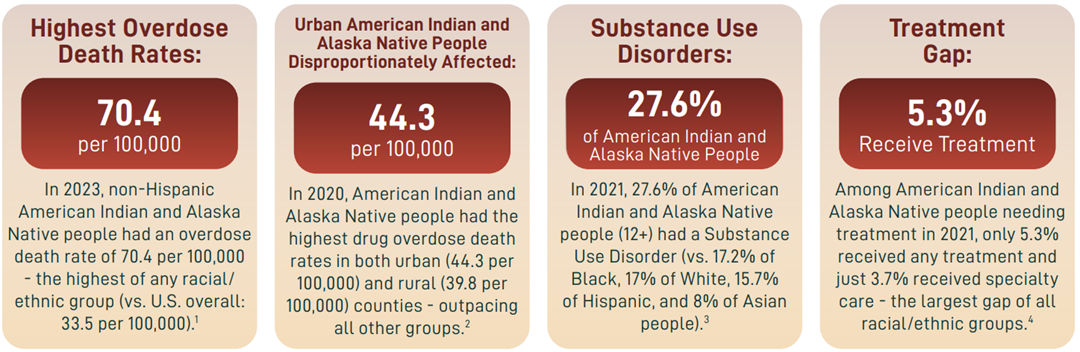
The National Council of Urban Indian Health (NCUIH) has released a new resource on Substance Use Disorder and Overdose in American Indian and Alaska Native Communities. This resource highlights the urgent need for increased support and funding to address the disproportionate impact of substance use disorder (SUD) and overdose among American Indian and Alaska Native (AI/AN) people.

The Crisis:


AI/AN communities continue to face the highest overdose death rates in the nation. Urban Indian Organizations (UIOs) are essential providers of culturally grounded prevention, treatment, and recovery services. However, they face persistent challenges, including limited resources, data access, and sustainable funding. The new resource provides key data, outlines barriers to care, and recommends policy solutions to strengthen UIOs’ ability to respond to this public health crisis.

Policy Solutions:

Fund the Behavioral Health and Substance Use Disorder Resources for Native Americans (BHSUDRNA) Program

Congress authorized the Behavioral Health and Substance Use Disorder Resources for Native Americans (BHSUDRNA) Program in the Consolidated Appropriations Act, 2023, to provide services for the prevention of, treatment of, and recovery from mental health and substance use disorders among American Indians, Alaska Natives, and Native Hawaiians.

  • Authorized Funding: $80 million for each of Fiscal Years (FY) 2023-2027.
  • Problem: No funds have been appropriated.
    • The President’s FY 2026 budget requested that $80 million be appropriated for this program. The House and Senate did not include this program in their FY 2026 appropriations bills.

Continuing Support for Tribal Behavioral Health Grants (Native Connections)

Native Connections is a five-year grant program that helps AI/AN communities identify and address the behavioral health needs of Native youth. The Native Connections grant program supports grantees in: reducing suicidal behavior and substance use among Native youth up to age 24; easing the impacts of substance use, mental illness, and trauma in tribal communities; and supporting youth as they transition into adulthood.

The Tribal Behavioral Health Grants line item in the Labor, Health and Human Services, Education, and Related Agencies appropriations bill funds the Native Connections program. Currently there are 12 UIOs who are active recipients.

  • Appropriations Status: Congress has maintained funding for this program in the proposed FY 2026 appropriations bills in each chamber. The Senate has proposed maintaining funding at the current level of $23.67 million. The House has proposed increasing funding to $30 million.

image_pdfPDFimage_printPrint

NCUIH Joins Families USA and 153 Partner Organizations in Urging Congress to Permanently Extend Enhanced Premium Tax Credits

On October 16, 2025, NCUIH joined Families USA and 153 partner organizations in signing a letter to Majority Leader Thune, Minority Leader Schumer, Speaker Johnson, and Minority Leader Jeffries calling on Congress to permanently extend enhanced premium tax credits (ePTCs) that help make health coverage more affordable for millions of Americans.

The letter emphasizes that allowing the enhanced credits to expire would cause more than 20 million people, including small business owners, older adults, and families with children, to face rising health costs or lose coverage altogether. If not extended, an estimated 4 million people could lose insurance, and 11 million people with incomes between 100 and 150 percent of the Federal Poverty Level would lose access to zero-dollar premium plans.

The loss of the ePTCs will also have a significant impact on American Indian and Alaska Native (AI/AN) people. The Urban Institute estimates that 318,000 American Indian and Alaska Native (AI/AN) people are enrolled in the Marketplace in 2025 under tax credits and 126,000 AI/AN people will lose their Marketplace coverage without ePTCs, representing a 40 percent reduction for AI/ANs currently covered. Increasing premiums, even modestly, creates barriers for people with limited incomes, forcing many to choose between paying for health care and basic necessities.

Read the Full Letter Text

Dear Majority Leader Thune, Minority Leader Schumer, Speaker Johnson, and Minority Leader Jeffries:  

As millions of families across the country struggle to pay for the high and rising cost of health care, the more than 150 undersigned organizations representing patients, workers, small businesses, health care providers, public health professionals and other health care stakeholders strongly urge Congress to permanently extend the enhancements to the premium tax credit without delay and without any changes that could place health coverage out of reach for millions of vulnerable Americans. 

Without a timely extension of the enhanced premium tax credits, more than 20 million people – including about 5 million small business owners and self-employed people, along with 6 million older adults – will see their health care costs skyrocket. Roughly 4 million people are projected to lose their coverage altogether due to the higher cost. Further, if the enhancements expire, the 11 million people with Marketplace coverage who have incomes between 100 and 150 percent of the federal poverty level ($15,650 to $23,475 for an individual in 2025) would lose access to a silver plan with zero-dollar premiums. Data shows that the availability of such plans ensured that more people, and on average healthier people, are enrolled in coverage — a significant driver of recent record low numbers of Americans who are uninsured. 

Increasing the monthly cost of health care coverage, even by relatively modest amounts, for people with limited income would create significant barriers for them to maintain coverage, putting them at risk of dropping out of coverage altogether due to added confusion and red tape. Lowering income eligibility would particularly harm older adults, people in rural areas, and families with children by exposing them to skyrocketing costs. Those who could somehow manage to maintain their coverage might be forced to forgo other basic needs in order to pay for it. This reality further threatens people’s ability to treat ongoing health conditions like diabetes, heart disease, and cancer, as well as respond to new threats to their health.  

Changes made earlier this year in H.R.1 only compound the negative impact that losing enhanced premium tax credits will have by making vulnerable families unable to re-enroll in coverage if they fail to pay even a minimal premium. In that event, they would be ineligible for coverage for an entire year until the next Open Enrollment period – leaving millions vulnerable to even higher medical bills and greater uncompensated care costs for hospitals and health care providers already on the brink.  

The harms from eliminating these specific tax credits would be felt most acutely by people in states that have failed to expand Medicaid eligibility, including Alabama, Florida, Georgia, Kansas, Mississippi, South Carolina, Tennessee, Texas, Wisconsin, and Wyoming. Collectively, over six million people in those states who do not have access to Medicaid coverage with annual incomes below $21,597 are eligible for health care tax credits and a plan with zero-dollar premiums because of the enhancements. Texas, Florida, Georgia, and South Carolina in particular are among the top states in the country in terms of having the largest number of residents utilizing enhanced premium tax credits to get coverage. 

Raising health costs for people living paycheck to paycheck will endanger people’s health while making their financial predicament even more dire. To avoid this outcome, Congress must quickly extend the health care tax credits across all currently eligible income levels, including access to a zero-dollar premium plan for the most vulnerable families. We urge you and your colleagues to act without delay.  

Read the full letter here. 

image_pdfPDFimage_printPrint

NCUIH Releases New Toolkit to Help Urban Indian Organizations Engage Members of Congress

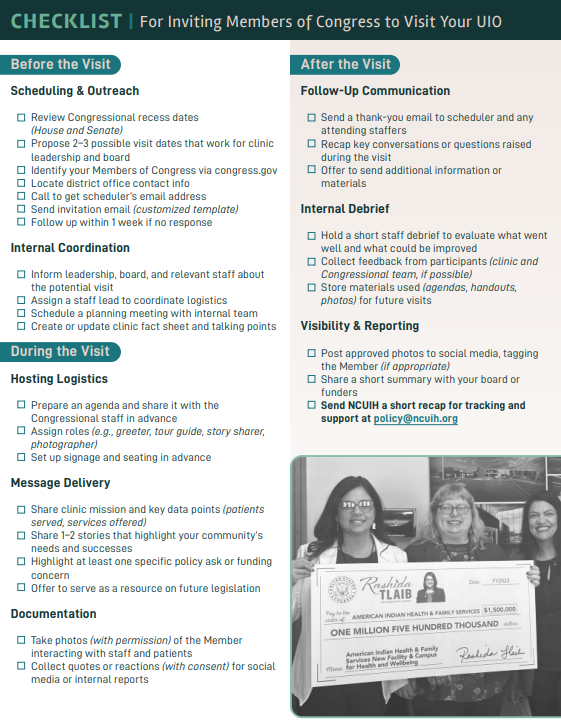
The National Council of Urban Indian Health (NCUIH) has released a new resource to support Urban Indian Organizations (UIOs) in strengthening relationships with policymakers: A How-To Toolkit for Inviting Members of Congress to Visit Your Urban Indian Organization. 

NCUIH Releases New Toolkit to Help Urban Indian Organizations Engage Members of CongressThis new toolkit provides step-by-step guidance for UIOs to invite and host Members of Congress, which provides an opportunity to showcase services provided to American Indian and Alaska Native (AI/AN) people living in urban areas, share community impact, raise awareness of urban Indian health needs, and highlight the importance of federal support for UIOs. 

Developed by NCUIH in collaboration with the Global Health Advocacy Incubator, the toolkit includes: 

  • Step-by-step instructions and best practices for scheduling a congressional visit.  
  • Template email language to help connect with congressional schedulers.  
  • Tips for highlighting the impact of UIOs and issues facing Native communities in urban areas.  
image_pdfPDFimage_printPrint

Press Release: NCUIH Launches RSV Vaccine Toolkit to Support RSV Prevention in Native Communities

FOR IMMEDIATE RELEASE

WASHINGTON, D.C. (October 22, 2025)– NCUIH is proud to share the launch of a new RSV Toolkit, developed to support health care providers in protecting Native communities from RSV.

Respiratory Syncytial Virus (RSV) is a common respiratory virus that usually causes mild, cold-like symptoms but can lead to serious illness in infants, young children, and older adults. RSV is highly contagious and can harm elders and babies. American Indian and Alaska Native children experience disproportionately higher rates of RSV-related hospitalization and ICU admission when compared to other U.S. infants.

“RSV can cause serious respiratory illness in infants and young children, with Native children facing even higher risks. As a pediatric nurse, I’ve cared for too many babies suffering from severe RSV and witnessed the heavy toll it takes on families. At the time, there were no protection options available for babies, and it often left me feeling helpless. Today, I’m grateful to help raise awareness about RSV and share the ways we can now protect our future knowledge keepers and storytellers.”
– Alyssa Smith-Longee (Assiniboine/Sioux – Fort Peck), NCUIH Public Health Program Manager

Health care providers can help protect Native communities!

The toolkit features 20 graphics—including both real-life photos and storyteller-inspired illustrations—paired with ready-to-use social media posts. Together, we can raise awareness about RSV prevention and highlight the power of community care.

We encourage you to share the toolkit on your channels using #NCUIH and tag us to help us amplify these important messages.

Access the toolkit at ncuih.org/RSV and join us in protecting our youngest and most vulnerable relatives this RSV season.

About the Storyteller Design

These storyteller illustrations draw inspiration from Pueblo clay sculptures with roots that extend deep into generations of tradition. The modern storyteller figurine was first created in 1964 by Helen Cordero of Cochiti Pueblo, who gave visual life to the oral practice of passing down lessons, values, history, and ways of life. Today, storyteller figurines remain among the most cherished forms of clay art, with artists shaping their storytellers to reflect diverse traditions and beliefs. The open mouth of each figurine represents the act of sharing stories with the children gathered around it. This campaign continues that legacy, raising awareness about RSV to protect our most vulnerable, including babies and young children, and safeguarding the next generation of storytellers and knowledge keepers.

Social Media Copy and Graphics

8 different graphics for social media are available, including illustrated and photo versions.


Newsletter Copy and Graphics

We have drafted text copy for your newsletters and included illustrated and photo versions of graphics as well.

Posters

Download and printable posters are available with 4 different illustrations.

Native Health Protection Network

We’re uniting health professionals who are dedicated to protecting Native families through strong immunization practices and culturally grounded care.

The Native Health Protection Network is a new circle for peer learning, sharing strategies, and strengthening vaccine confidence. This network will connect members to timely updates and resources designed to support vaccine readiness. Members can expect to receive email updates from NCUIH at least quarterly that will share exclusive insights, any updates to vaccine recommendations, and tailored resources and tools to boost vaccine knowledge. Those wishing to stay up to date with the latest vaccine recommendations are encouraged to sign up.

By signing up, members will receive quarterly email updates with:

  • Tailored communications and educational tools to support your community’s immunization efforts
  • Exclusive insights and the latest vaccine recommendations
  • Reminders of upcoming NCUIH vaccine Community of Learning sessions

About NCUIH

The National Council of Urban Indian Health (NCUIH) is a national representative for the 41 Urban Indian Organizations contracting with the Indian Health Service under the Indian Health Care Improvement Act. NCUIH is devoted to the support and development of high quality and accessible health and public health services for American Indian and Alaska Native people living in urban areas.

NCUIH respects and supports Tribal sovereignty and the unique government-to-government relationship between our Tribal Nations and the United States. NCUIH works to support those federal laws, policies, and procedures that respect and uplift Tribal sovereignty and the government-to-government relationship. NCUIH does not support any federal law, policy, or procedure that infringes upon or in any way diminishes Tribal sovereignty or the government-to-government relationship.

###

NCUIH Contact: Meredith Raimondi, Vice President of Policy and Communications, mraimondi@ncuih.org

image_pdfPDFimage_printPrint

NCUIH October Policy News: Shutdown Impacts, Federal Updates, and Budget Formulation Prep

In this Edition:

🧰 New Toolkit: NCUIH releases a step-by-step guide to help UIOs invite Members of Congress to visit their clinics.

⚠️ Government Shutdown: Congress fails to pass a Continuing Resolution; IHS operations continue through advance appropriations—IHS funding for UIOs is protected.

📢 Rapid Response: The Coalition for Tribal Sovereignty coordinated a joint letter to the Office of Management and Budget and an Action Alert for UIOs to advocate for Tribal-serving federal employees.

⚖️ Parity & Partnerships: Urban Indian Health Parity Act reintroduced; NCUIH urges bipartisan support.

🏥 Graduate Medical Pilot: VA launches PPGMER program—UIOs eligible; applications due Nov. 28.

🏛️ Federal Engagement: NCUIH meets with HHS Secretary Kennedy; STAC raises hiring freeze, staffing, and 340B concerns.

🧠 Behavioral Health: SAMHSA Native Connections grants released; NCUIH pushes for $30M funding increase in FY 2026.

🌾 Rural Health Transformation: CMS opens $50B RHTP funding for states; applications due Nov. 5.

📅 Event Updates: IHS UIO and Partner Summit postponed; NCUIH Congressional Briefing on SUD/Overdose prevention tentatively Oct. 27.

📊 FY 2028 Budget Formulation: Area consultations begin this month; NCUIH provides PowerPoint templates and TA for UIO participation.

FY 2028 Area Budget Formulation: Preparation and Tools

Why Participation Matters

  • Area consultations directly shape recommendations for national funding priorities. Each Area’s input helps determine the Urban Indian Health line item, which is averaged from regional proposals.

UIO engagement ensures that urban needs are accurately reflected in IHS budget planning.

How NCUIH is Supporting UIOs

  • Each UIO will receive an Area-specific PowerPoint template with highlighted sections to customize for your clinic and region.
  • NCUIH offers technical assistance and can help review slides or testimony before submission.

📅 Upcoming Area Consultations

  • Nashville: October 29 (Virtual)
  • Oklahoma City: November 5–6 (Hybrid)
  • Bemidji: November 18–19 (Wisconsin Dells, WI)
  • Phoenix: December 2–3 (Hybrid)
  • California: December 10
  • If your area is not listed, we have not received any information yet. Please let us know if you have heard an announcement for your area.

To schedule a prep session, contact policy@ncuih.org.

Appropriations and the Government Shutdown

When Congress failed to pass a continuing resolution by September 30, the federal government entered a shutdown.

  • IHS operations mainly continued thanks to advance appropriations.
  • On October 1, NCUIH convened a rapid response call with UIOs and issued a press release to Capitol Hill.
  • Together with CTS, NCUIH sent a letter to OMB requesting an exemption for federal employees serving Tribal Nations during any shutdowns.
  • A CTS Action Alert was shared with UIOs, including a template letter, talking points, and list of federally funded Tribal accounts.

New Resource: Toolkit on Inviting Members of Congress to Visit Your Urban Indian Organization
NCUIH released a new toolkit designed to help Urban Indian Organization (UIO) leaders invite members of Congress to visit their clinics.
The guide includes:

  • Step-by-step instructions and best practices for scheduling a congressional visit.
  • Template email language to help connect with congressional schedulers.
  • Tips for highlighting the impact of UIOs and issues facing Native communities in urban areas.

These visits serve as powerful opportunities to build relationships and raise awareness of Urban Indian health needs.

Legislative Updates

Urban Indian Health Parity Act (H.R. 4722) 

  • Reintroduced by Reps. Ruiz (CA-25) and Bacon (NE-02), this bipartisan bill would ensure UIOs receive parity in health program funding.

👉 Action for UIOs: Email Republican offices to sign on as co-sponsors.

New VA Pilot Program on Graduate Medical Education and Residency (PPGMER) – UIOs Eligible 

This new program supports physician rotations at IHS, Tribal, and UIO facilities.

NCUIH encourages UIOs to apply for eligibility under this program to strengthen urban Native clinical training capacity.

Federal Engagement: STAC and HHS Updates

At the HHS Secretary’s Tribal Advisory Committee (STAC) meeting (Sept. 23–25): 

  • NCUIH met with HHS Secretary Kennedy, advocating for continued support for Urban Indian health, the end of the federal hiring freeze and increased IHS staffing.
  • IHS reported over 1,000 vacancies since January, despite adding 70 Commissioned Corps officers.
  • STAC members requested:
  • A Native representative on the new HHS Healthcare Advisory Committee.
  • A Tribal exemption from HRSA’s 340B rebate pilot program.
  • Litigation continues to prevent HHS from implementing its proposed reorganization.

Grant and Funding Update

SAMHSA Native Connections Grant 

Several UIOs faced grant delays this year, prompting NCUIH to elevate the issue to HHS and provide STAC talking points.

  • All FY 2025 grants have now been released.

For FY 2026:

  • Senate proposal: Maintain current $23.67M level.
    House proposal: Increase funding to $30M.
  • NCUIH continues to advocate for the higher House amount.

SAMHSA leadership reaffirmed the program’s importance:

“This program is so impactful for Tribal communities.” — Arthur Kleinschmidt, SAMHSA Principal Deputy Assistant Secretary, Sept. 24

CMS Rural Health Transformation Program (RHTP)

  • On October 8, CMS held an All-Tribes webinar on the $50 Billion Rural Health Transformation Program under the One Big Beautiful Bill Act.
  • State applications due: November 5, 2025
  • The program aims to strengthen rural and Tribal health systems through innovative funding models.

Highlighted Action from the Coalition for Tribal Sovereignty

► Coalition for Tribal Sovereignty (CTS) 

CTS Action Alert to reach out to OMB and Members of Congress– shared with all UIOs​

  • Includes template letter, talking points, and a list of funded accounts with Tribal implications.

About CTS: The Coalition for Tribal Sovereignty (CTS) is a collaborative alliance that serves as a powerful unifying voice of regional and national inter-tribal policy-oriented, non-profit organizations to engage with federal policymakers on critical issues affecting the sovereign interests, rights, and authorities of Tribal Nations, tribal citizens, and community members across the United States.

Upcoming Events and Meetings

Postponed: IHS UIO and Partner Federal Agencies Summit

  • Originally planned for October 21–22, now postponed due to the shutdown.
  • The UIO Caucus (October 20) has also been canceled.
  • New dates will be announced once federal operations resume.

Upcoming Events 

  • November 3: NIHB MMPC meeting ahead of CMS Tribal Technical Advisory Group (TTAG)
  • November 12–13: CMS TTAG Quarterly Meeting (DC)
  • November 16–21: NCAI Annual Convention & Marketplace (Seattle, WA)
  • November 19: NCUIH Monthly Policy Workgroup (Virtual)

About NCUIH

The National Council of Urban Indian Health (NCUIH) is a national representative for the 41 Urban Indian Organizations contracting with the Indian Health Service under the Indian Health Care Improvement Act. NCUIH is devoted to the support and development of high quality and accessible health and public health services for American Indian and Alaska Native people living in urban areas.

NCUIH respects and supports Tribal sovereignty and the unique government-to-government relationship between our Tribal Nations and the United States. NCUIH works to support those federal laws, policies, and procedures that respect and uplift Tribal sovereignty and the government-to-government relationship. NCUIH does not support any federal law, policy, or procedure that infringes upon or in any way diminishes Tribal sovereignty or the government-to-government relationship.
image_pdfPDFimage_printPrint

Policy Alert: Advance Appropriations for Indian Health Services Proves Critical in Shutdown, Blanket Exceptions Needed to Protect All Tribal Programs

On September 30, 2025, Congress failed to reach an agreement on the House-passed Continuing Resolution (CR) to maintain FY 2025 funding through November 21. This failure resulted in the expiration of government funding and the first shutdown in six years. A government shutdown halts most discretionary funding, forces widespread staff furloughs, and may trigger Reductions in Force (RIFs).

“Advance funding for the Indian Health Service is saving lives today. This Administration and Congress have committed to the fulfillment of trust and treaty responsibilities. We urge Congress and the Administration to extend exceptions to all of Indian Country to reduce any further impacts and protect our communities.” – Francys Crevier (Algonquin), CEO of NCUIH.

NCUIH Action

On September 29, 2025, NCUIH signed on to a letter by the Coalition for Tribal Sovereignty (CTS) to OMB Director Russell Vought  calling for an immediate directive to except all federal employees serving Tribal Nations, Tribal citizens, and Tribal communities from any shutdown-related furloughs or reductions in force. In addition to the letter, CTS provided Director Vought with a list of funded accounts essential to protecting health services, housing, and public safety in Indian Country.

NCUIH echoes this call, stressing the urgent need for a blanket exception for all programs serving Indian Country, particularly as reports emerge of HHS staff working on IHS-related programs being furloughed.

Impacts on Indian Country

Indian Health Service (IHS)

Fortunately, due to strong bipartisan support, the Indian Health Service (IHS) received advance appropriations for FY 2026, meaning IHS will continue to receive funding and all 14,801 IHS staff will be protected from furloughs. Urban Indian Organizations are covered under the advance appropriations. While most IHS operations will continue unimpacted, several IHS accounts do not receive advance appropriations. These include facilities construction, sanitation facilities construction, Contract Support Costs and 105(l) leases, the Indian Health Care Improvement Act Fund, and Electronic Health Records line item.

Health and Human Services (HHS)

The HHS Contingency Plan states that 32,460 employees (41%) will be furloughed, and HHS will cease all non-exempt and non-excepted activities.  HHS programs are critical for Urban Indian Organizations (UIOs) and Tribal organizations. While some programs are insulated because they do not rely on an October 1 funding cycle, HHS agencies cannot award new grants during a shutdown. In addition, existing grant management activities may be deemed non-essential, leading to delays in communication and possible disruptions in disbursements.

Next Steps

There is no clear indication of how long this shutdown will last. The Senate is expected to continue debating the House-passed CR through the weekend, while the House of Representatives is not expected to return until next week.

NCUIH will work with Tribal partners, federal agencies, and congressional allies to minimize the shutdown’s impact on American Indian and Alaska Native communities.

Past experience shows any disruption in funding in the Indian health system can have grave consequences. During the 2019 government shutdown, funding disruptions led to reduced services and facility closures, resulting in tragic consequences including loss of life due to opioid overdoses in some communities.

We urge policymakers to prioritize Tribal health and safety by ensuring that all Tribal-serving staff and programs are fully protected.

NCUIH Contact: Meredith Raimondi, Vice President of Policy and Communications, mraimondi@ncuih.org

image_pdfPDFimage_printPrint