NCUIH Resource Highlights Substance Use Disorder and Opioid Crisis in Native Communities, Proposes Policy Solutions
The National Council of Urban Indian Health (NCUIH) has released a new resource on Substance Use Disorder and Overdose in American Indian and Alaska Native Communities. This resource highlights the urgent need for increased support and funding to address the disproportionate impact of substance use disorder (SUD) and overdose among American Indian and Alaska Native (AI/AN) people.
The Crisis:
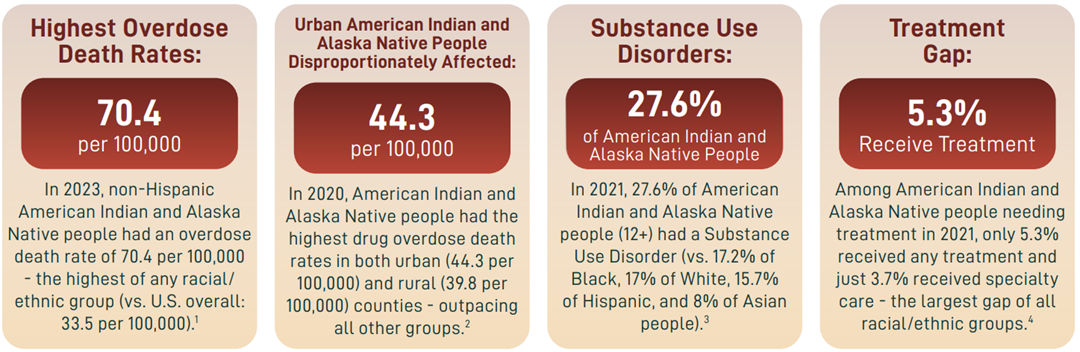
AI/AN communities continue to face the highest overdose death rates in the nation. Urban Indian Organizations (UIOs) are essential providers of culturally grounded prevention, treatment, and recovery services. However, they face persistent challenges, including limited resources, data access, and sustainable funding. The new resource provides key data, outlines barriers to care, and recommends policy solutions to strengthen UIOs’ ability to respond to this public health crisis.
Policy Solutions:
Fund the Behavioral Health and Substance Use Disorder Resources for Native Americans (BHSUDRNA) Program
Congress authorized the Behavioral Health and Substance Use Disorder Resources for Native Americans (BHSUDRNA) Program in the Consolidated Appropriations Act, 2023, to provide services for the prevention of, treatment of, and recovery from mental health and substance use disorders among American Indians, Alaska Natives, and Native Hawaiians.
- Authorized Funding: $80 million for each of Fiscal Years (FY) 2023-2027.
- Problem: No funds have been appropriated.
- The President’s FY 2026 budget requested that $80 million be appropriated for this program. The House and Senate did not include this program in their FY 2026 appropriations bills.

Continuing Support for Tribal Behavioral Health Grants (Native Connections)
Native Connections is a five-year grant program that helps AI/AN communities identify and address the behavioral health needs of Native youth. The Native Connections grant program supports grantees in: reducing suicidal behavior and substance use among Native youth up to age 24; easing the impacts of substance use, mental illness, and trauma in tribal communities; and supporting youth as they transition into adulthood.
The Tribal Behavioral Health Grants line item in the Labor, Health and Human Services, Education, and Related Agencies appropriations bill funds the Native Connections program. Currently there are 12 UIOs who are active recipients.
- Appropriations Status: Congress has maintained funding for this program in the proposed FY 2026 appropriations bills in each chamber. The Senate has proposed maintaining funding at the current level of $23.67 million. The House has proposed increasing funding to $30 million.
