Partnership for Medicaid Urges CMS Guidance for AI/AN Medicaid Exemptions Under the One Big Beautiful Bill Act

On November 25, 2025, NCUIH joined the Partnership for Medicaid in a letter to the Centers for Medicare and Medicaid Services (CMS) Administrator Mehmet Oz sharing requests and recommendations regarding the implementation of the One Big Beautiful Bill Act (OBBBA) (H.R. 1). NCUIH worked with the Partnership to urge CMS to reiterate the exemption of American Indian and Alaska Native (AI/AN) beneficiaries from the new Medicaid requirements in its guidance to states.

Read the full letter here.

Background on OBBBA and AI/AN Medicaid Exemptions

On July 4, 2025, the President signed the OBBBA into law. The OBBBA is a major bill that delivers many elements of President Trump’s legislative agenda, including new requirements for access to Medicaid and Supplemental Nutrition Assistance Program (SNAP). Indians, Urban Indians, California Indians, and individuals determined eligible as an Indian for the Indian Health Service under regulations promulgated by the Secretary are exempted from the Medicaid requirements in the OBBBA and included in exemptions for the SNAP work requirements.

Read more about these exemptions in NCUIH’s overview of the OBBBA resource.

About the Partnership for Medicaid

NCUIH is a member of the Partnership for Medicaid, which is a nonpartisan, nationwide coalition of organizations representing clinicians, health care providers, safety-net health plans, and counties. The goal of the coalition is to preserve and improve the Medicaid program.

image_pdfPDFimage_printPrint

NCUIH Releases 2025 Annual Policy Assessment

The Policy Assessment informs Urban Indian Organizations policy priorities for 2026, identifies barriers to closing funding gaps, opportunities to strengthen the workforce, and building community resources for Urban Native communities.

The National Council of Urban Indian Health (NCUIH) is pleased to announce the release of its 2025 Policy Assessment. This assessment was developed based on the 5 focus groups by UIO facility type (full ambulatory, limited ambulatory, outreach and referral, and outpatient and residential) between October 7-9, 2025, as well as a written survey sent out via email to all 41 UIO leaders. The focus groups and survey provided an invaluable opportunity to reflect on the achievements and challenges of 2025, fostering a deeper understanding of the progress made and the areas that require further attention.

Together these focus groups allow NCUIH to work with UIOs to identify policy priorities in 2026 and identify barriers that impact delivery of care to Native patients and their communities. Of the 41 UIOs, 20 attended the focus groups and/or participated in a survey. This is the sixth year that NCUIH has conducted the assessment via focus groups sessions.

Overview of the Policy Assessment

During the focus group sessions, UIO leaders had the opportunity to share their opinions on the successes and challenges they experienced in 2025. UIO leaders also provided input on the policy areas they would like to see the greatest policy support from NCUIH. Some of the key policy priority areas identified included increasing funding for IHS and urban Indian health line items, the importance of advance appropriations, securing 100% Federal Medical Assistance Percentage (FMAP) for UIOs, and implementing food is medicine programs.

Key Findings from the Policy Assessment are as follows:

  • Advance Appropriations for the Indian Health Service Prove Critical to Maintaining Services in the Shutdown
  • Impacts of Federal Policy Changes on Urban Indian Organization Funding
  • Impact of DEIA Executive Orders on Urban Indian Organizations
  • Achieving Parity: Extending 100% Federal Medicaid Assistance Percentage to Urban Indian Organizations
  • Strengthening the Workforce to Support Urban Indian Organizations
  • Food is Medicine: Addressing Food Insecurity and Health

Next Steps

NCUIH will use this assessment to develop a comprehensive document of the 2026 Policy Priorities.

Past Assessments and Priorities

image_pdfPDFimage_printPrint

NCUIH December Policy Update: Legislative, Agency, and IHS Developments

In this Edition:

  • 📊 Government Shutdown Ended & FY 2025 Funding Extended
  • 🤝 NCUIH at the 2025 NCAI Annual Convention & Marketplace
  • 💻 NCUIH Comment Submission on IHS Health IT Modernization
  • 🏷 NCUIH Requests UIO Exemption from HRSA’s 340B Rebate Model Pilot Program
  • 🗓 IHS Tribal Consultation & Urban Confer on Agency Realignment
  •  🩺 Updates from the IHS Tribal Leaders Diabetes Committee (TLDC)
  •  💬 CMS Tribal Technical Advisory Group (TTAG) Meeting Highlights
  •  📘 CMS Guidance on AI/AN Exemptions in OBBBA Medicaid Work Requirements
  •  📝 CMS Informational Bulletin on OBBBA Medicaid & CHIP Provisions
  •  👥 Federal Hiring Freeze Lifted & IHS Staffing Updates
  •  🎗 IHS Request for Urban Cancer Care Services Data for Mapping Initiative
  •  📈 IHS FY 2028 Budget Formulation Updates

NEW: Strategy Guide Release — Strategy 1: Strengthening Health Care Access for Urban American Indian and Alaska Native People

This month, NCUIH released Strategy 1 of our new multi-part Strategy Guide series designed to support Urban Indian Organizations in delivering high-quality, culturally grounded health care. Building on our Investing in Wellness: Financing Strategies for Behavioral Health in Indian Country work, Strategy 1 outlines practical ways to strengthen Medicaid reimbursement for behavioral health services and expand sustainable financing options that support prevention, treatment, and recovery efforts at UIOs

Explore Strategy One Material and Resources for UIOs: Visit the NCUIH Website

Government Shutdown Ended, Government Funded through End of January

On November 12, Congress passed a spending package keeping FY 2025 funding through January 30, 2026.
• SDPI funded at $53.15 million through January.
• Enhanced ACA subsidies were not extended.
• The Continuing Resolution (CR) reversed all Reduction In Force (RIF) actions taken since October 1 and prevents further RIFs during the CR period.
→ Go Deeper: Link to NCUIH analysis.

NCUIH in Action

NCAI 2025 Annual Convention & Marketplace

NCUIH President Walter Murillo co-chaired the Health Subcommittee.
Health resolutions that passed included:

  • UIO inclusion in Medicaid 1115 waivers
  • 15% HHS Tribal set-aside
  • Protecting IHS in Medicaid reforms
  • Extending FEHB to Tribal retirees
  • Safeguarding AI/ANs in OBBBA
  • Codifying HHS Tribal advisory committees
  • Preserving Medicaid reimbursement rates
  • Supporting Native youth leadership in substance-abuse prevention

NCUIH also participated in:

  • December 4 – Pharmaceutical Research and Manufacturers of America Annual Holiday Partner Celebration  – Connecting with health sector partners and stakeholders.

  • December 9- Partnership for Medicaid End-of-Year Meeting – Strengthening collaboration with coalition members and contributing to shared Medica55id policy priorities affecting Urban Indian Organizations.

  • December 11 – NCUIH with Rep. Adelita Grijalva (AZ-07) at the House Natural Resources Subcommittee on Indian and Insular Affairs hearing on Modernizing the Implementation of 638 Contracting at the Indian Health Service.

NCUIH Comment Submission on Indian Health Service Health Information Technology Modernization

NCUIH Comment Submission on Indian Health Service Health Information Technology Modernization

  • Background: NCUIH submitted comments requesting clarity on 24-hour technical support, functionalities of the Patients at the Heart electronic health record, documentation pathways for Traditional Healing, and continued engagement with Urban Indian Organizations.
  • NCUIH recommended: Ongoing consultation and transparent implementation planning.

NCUIH Request for Urban Indian Organization Exemption from 340B Rebate Pilot

  • Background: NCUIH submitted a formal letter requesting the Health Resources and Services Administration to exempt Urban Indian Organizations and Indian Health Care Providers from the proposed 340B Rebate Model Pilot due to financial and administrative burdens.
  •  NCUIH recommended: Full exemption for the Indian Health Service, Tribal, and Urban Indian health system.

Indian Health Service Agency Realignment Tribal Consultation and Urban Confer

February 9, 2026 — Indian Health Service Agency Realignment Tribal Consultation and Urban Confer 

  • Background: The Indian Health Service is gathering Tribal and Urban Indian Organization feedback on its proposed organizational realignment.
  • What’s Next: Written comments are due February 9, 2026, and may be submitted through the Indian Health Service consultation portal or emailed to urbanconfer@ihs.gov.

UIO Important Dates:

  • Urban Confer (virtual only): Thursday, January 15, 2026, 1:00 – 4:00 PM ET (rescheduled from Jan. 8)
  • NCUIH will be holding a virtual prep session for UIOs on January 14, 2026, at 1pm ET.

Tribal Consultations  

UIOs are invited to the Tribal Consultations in-person to listen. 

  • December 15, 2025, 1:00 – 4:00 PM CT (Durant, OK)
  • December 16, 2025, 1:00 – 4:00 PM MT (Denver, CO)
  • December 17, 2025, 1:00 – 4:00 PM PT (San Diego, CA)
  • December 22, 2025, 2:00 – 5:00 PM ET (Virtual)
  • January 5, 2026, 1:00 – 4:00 PM MST (Flagstaff, AZ)
  • January 6, 2026, 1:00 – 4:00 PM PT (Seattle, WA)
  • January 7, 2026, 1:00 – 4:00 PM MST (Billings, MT)
  • January 8, 2026, 1:00 – 4:00 PM CST (Green Bay, WI)

Upcoming Events and Important Dates

IHS & Federal Agency Updates

IHS Tribal Leaders Diabetes Committee (TLDC) — Dec. 2 

  • SDPI FY 2026 funding: 6-month awards (Jan–June); remainder to be issued when Congress fully authorizes SDPI.

TLDC recommended: 
– 25% administrative supplements to all SDPI recipients (2026–27)
– Sharing area-level unobligated balances
– SDPI data impact analysis

Centers for Medicare & Medicaid Services Informational Bulletin Update

CMS TTAG Meeting — Dec. 8

  • Tribal guidance on OBBBA coming this winter.
  • CMS DTA pursuing Tribal exemption for HRSA’s 340B Model Rebate Pilot.
  • Ongoing vacancies: IHS Director and CMS DTA Director positions.
  • CMS encourages Tribal–state engagement for RHTP implementation.

On November 18, the Centers for Medicare & Medicaid Services issued an informational bulletin clarifying how Medicaid and Children’s Health Insurance Program provisions in the One Big Beautiful Bill Act apply to American Indians and Alaska Natives. The bulletin confirms that eligibility redeterminations, Medicaid community engagement requirements, and modified cost-sharing provisions do not apply to eligible American Indian and Alaska Native individuals, including Urban Indians. Additional guidance issued on December 8 reiterates that American Indians and Alaska Natives are excluded from Medicaid work requirements.

Federal Hiring Freeze Ended — Oct. 15 

  • IHS is preparing staffing plans under the Continued Accountability in the Federal Government’s Employment Executive Order.
  • Vacancies will begin to be filled once the plan approved.

IHS Staffing Updates 

  1. Clayton Fulton now carries out duties of Acting IHS Director.
  2. Benjamin Smith returns to Deputy Director.
  3. Darrell LaRoche resumes Deputy Director for Management.
  4. Dr. Rose Weahkee returns to Associate Deputy Director for Management Operations.

IHS Health IT Modernization — NCUIH Comments Submitted 
NCUIH requested:
• Clarification on 24-hour national helpdesk function
• Details on PATH EHR capabilities
• Support for Traditional Healing documentation
• Continuous engagement with UIOs throughout modernization

IHS Request for Urban Cancer Care Services Data 

IHS FY 2028 Budget Formulation 
• Tribal request: $29.8 billion mandatory funding for IHS
• January 21–22, 2026: Area report presentations
• February 10–11, 2026: National Budget Formulation Work Session

BADGES for Native Communities Act Update 

  • On December 12, 2025, the Bridging Agency Data Gaps and Ensuring Safety for Native Communities Act unanimously passed the United States Senate and now advances to the House of Representatives.
  • The bipartisan legislation strengthens Tribal public safety, improves reporting on Missing or Murdered Indigenous Peoples, and establishes a grant program to support coordinated response efforts.
  • Urban Indian Organizations are eligible entities under the grant program.

Reminder: One Big Beautiful Bill Act Resource for Urban Indian Organizations

NCUIH has developed a resource to help Urban Indian Organizations understand Medicaid and Children’s Health Insurance Program provisions under the One Big Beautiful Bill Act. The resource outlines which provisions apply to Urban Indian Organizations and clarifies protections and exemptions for American Indian and Alaska Native patients during state-level implementation.

UIO Input Request

NCUIH is continuing to engage with federal partners on several policy developments that may affect Urban Indian Organizations, including Indian Health Service (IHS) Realignment efforts and broader discussions related to care delivery and program administration.

To strengthen NCUIH’s advocacy and ensure UIO perspectives are accurately reflected,we invite UIOs to share feedback and experiences related to the following: 

  • IHS Realignment Participation: Are you planning to attend any upcoming in-person consultations related to IHS Realignment?
  • Realignment Concerns: Do you have concerns or considerations regarding the proposed IHS Realignment, particularly as it relates to UIO operations or service delivery?
  • Contract Centralization: How might the proposed centralization of contracts at IHS Headquarters, rather than through Area Offices, impact your organization? Are there specific concerns you would like NCUIH to elevate?
  • Food is Medicine Programs: Do any UIOs currently operate or plan to develop Food is Medicine programs specifically designed to support cancer patients?

Feedback shared will help inform NCUIH’s ongoing policy engagement, written comments, and participation in consultations and advisory discussions.

How to respond: UIOs are encouraged to share feedback by emailing policy@ncuih.org.

Save the Date: 2026 NCUIH Annual Conference

Join us for our 2026 Annual Conference on April 27–30, 2026, at The Westin Downtown in Washington, D.C. The conference will bring together Urban Indian Organizations, health leaders, policymakers, and partners to share strategies, strengthen systems, and advance urban Indian health nationwide. Programming includes UIO board training, two full days of conference sessions, and a Hill Day for Urban Indian Organizations. NCUIH is also accepting session and poster proposals, with submissions due January 15, 2026.

One Last Thing — Check Out This Upcoming Funding Opportunity

Urban Indian Organizations can now apply for funding to support culturally grounded overdose prevention projects.

Applications are due January 16, 2026, with awards of up to $45,000.

Our partners at Seven Directions and the National Network of Public Health Institutes are sharing materials to help spread the word—please repost or use the linked graphics to share this opportunity with your community.

About NCUIH

The National Council of Urban Indian Health (NCUIH) is a national representative for the 41 Urban Indian Organizations contracting with the Indian Health Service under the Indian Health Care Improvement Act. NCUIH is devoted to the support and development of high quality and accessible health and public health services for American Indian and Alaska Native people living in urban areas.

NCUIH respects and supports Tribal sovereignty and the unique government-to-government relationship between our Tribal Nations and the United States. NCUIH works to support those federal laws, policies, and procedures that respect and uplift Tribal sovereignty and the government-to-government relationship. NCUIH does not support any federal law, policy, or procedure that infringes upon or in any way diminishes Tribal sovereignty or the government-to-government relationship.
image_pdfPDFimage_printPrint

PRESS RELEASE: New Government Prescription Program Threatens Native Health Access, Exemption Needed for Indian Health Care Providers

FOR IMMEDIATE RELEASE

WASHINGTON, D.C. (December 17, 2025) – On December 8, 2025, the NCUIH sent a letter to HRSA Administrator, Thomas J. Engels, to request an exemption for UIOs and Indian Health Care Providers from the 340B Rebate Model Pilot Program. This request is consistent with a Tribal request that has been made by both the HHS Secretary’s Tribal Advisory Committee (STAC) and the Centers for Medicaid and Medicare Services (CMS) Tribal Technical Advisory Group (TTAG).

The National Council of Urban Indian Health (NCUIH) calls on the Health Resources and Services Administration (HRSA) to exempt Urban Indian Organizations (UIOs) and Indian Health Care Providers from HRSA’s 340B Rebate Model Pilot Program. This urgent request is to prevent the administrative and financial burden on UIOs and Indian Health Care Providers, and barriers to access to vital medications for American Indian and Alaska Native patients.

The Impact

Under the HRSA 340B Rebate Model Pilot Program, scheduled to begin January 1, 2026, covered entities will no longer receive 340B discounts at the point of purchase. Instead, entities must pay full Wholesale Acquisition Cost (WAC) upfront for 10 select drugs and later submit claims to receive manufacturer rebates. Medications used to treat diabetes, cardiovascular disease, and autoimmune conditions will increase substantially in cost for UIOs, which do not have the reserves to cover these costs while awaiting uncertain rebate payments.

25 out of the 41 UIOs across the country currently participate in the 340B program. UIOs that participate in the 340B program often have limited cash reserves and narrow operating margins, relying on 340B savings to support pharmacy services and access to vital medications for their American Indian and Alaska Native patients. For UIOs and Indian Health Care Providers, this model creates an immediate risk that threatens patient access to care.

Stats

The rebate model shifts financial risk from manufacturers to health care providers, creating new financial and operational challenges for UIOs:

  • Preliminary UIO feedback indicates that upfront drug purchasing costs range from $340,000 to $2.4 million annually for some UIOs that participate in the 340B program. Even temporary delays in rebate payments may significantly strain UIO operating budgets.
  • The pilot introduces new requirements for rebate claim submission, tracking, and reporting. These changes may require additional staffing, IT system capacity, and administrative resources.
  • Increased financial and operational pressures may affect the sustainability of UIO pharmacy operations and limit the ability to stock or dispense high-cost medications, jeopardizing access to medications for American Indian and Alaska Native patients.

Resources

About NCUIH

The National Council of Urban Indian Health (NCUIH) is a national representative for the 41 Urban Indian Organizations contracting with the Indian Health Service under the Indian Health Care Improvement Act. NCUIH is devoted to the support and development of high quality and accessible health and public health services for American Indian and Alaska Native people living in urban areas.

NCUIH respects and supports Tribal sovereignty and the unique government-to-government relationship between our Tribal Nations and the United States. NCUIH works to support those federal laws, policies, and procedures that respect and uplift Tribal sovereignty and the government-to-government relationship. NCUIH does not support any federal law, policy, or procedure that infringes upon or in any way diminishes Tribal sovereignty or the government-to-government relationship.

###

NCUIH Contact: Meredith Raimondi, Vice President of Policy and Communications, mraimondi@ncuih.org

image_pdfPDFimage_printPrint

NCUIH Sends Letter to HRSA Seeking Exemption for UIOs and Indian Health Care Providers from the 340B Rebate Model Pilot Program

On December 8, 2025, the National Council of Urban Indian Health (NCUIH) sent a letter to the Health Resources and Services Administration (HRSA) Administrator, Thomas J. Engels, to request an exemption for Urban Indian Organizations (UIOs) and Indian Health Care Providers from HRSA’s 340B Rebate Model Pilot Program. NCUIH made this urgent request to prevent the administrative and financial burden of the Program on UIOs and Indian Health Care Providers. This request is consistent with a Tribal request that has been made by both U.S. Department of Health and Human Services’ (HHS) Secretary’s Tribal Advisory Committee (STAC) and the Centers for Medicaid and Medicare Services (CMS) Tribal Technical Advisory Group (TTAG).

Read the full letter here.

Background on the 340B Rebate Model Pilot Program

On July 31, 2025, HRSA announced the voluntary 340B Rebate Model Pilot Program for drugs on the Centers for Medicare and Medicaid Services’ (CMS) Medicare Drug Price Negotiation Selected Drug List for year 2026 from qualifying manufacturers meeting specific criteria. Under the Program, covered entities continue to make purchases through their 340B wholesaler account and request rebates on select drugs after the purchase is made. Read here for more information on the Program.

image_pdfPDFimage_printPrint

NCUIH-Endorsed Bipartisan Legislation Aimed at Strengthening Tribal Public Safety Passes Senate

On December 12, 2025, the National Council of Urban Indian Health (NCUIH)-endorsed legislation, the Bridging Agency Data Gaps & Ensuring Safety (BADGES) for Native Communities Act (S.390) unanimously passed the Senate and will now head to the House. Senators Catherine Cortez Masto (D-N.V.), John Hoeven (R-N.D.), Ruben Gallego (D-A.Z.) and Mike Rounds (R-S.D.) reintroduced this bipartisan legislation on February 4, 2025, which is aimed at strengthening Tribal public safety. 

Specifically, the bill:

  1. Requires law enforcement agencies to report on cases of Missing or Murdered Indigenous Peoples (MMIP). 
  2. Establish a grant program to support states, Tribes, and Tribal organizations in the coordination of efforts related to missing and murdered persons cases and sexual assault cases.
  3. Urban Indian Organizations (UIOs) are eligible entities for the missing or murdered response coordination grant program established by this bill. This could allow UIOs to establish and grow programs to assist in developing coordinated responses and investigations for MMIP.
  4. Increase Tribal access to the National Missing and Unidentified Persons System (NamUs) by requiring Tribal facilitators to conduct ongoing Tribal outreach and serve as a point of contact for Tribes and law enforcement agencies, as well as conduct training and information gathering to improve the resolution of missing persons cases.
  5. Require a report on Tribal law enforcement needs, including staffing, replacement and repairs for corrections facilities, infrastructure and capital for Tribal police and court facilities, and emergency communication technology. 
  6. Evaluate federal law enforcement evidence collection, handling, and processing crucial to securing conviction of violent offenders.

Read the bill text here.

Background

Missing and murdered Indigenous peoples (MMIP) is a crisis that refers to the disproportionate amount of violence and abuse that affects American Indian and Alaska Native people in the United States.  NCUIH surveyed UIO leaders in 2019 on the biggest risk factors leading to American Indian and Alaska Native patients missing in their communities, and 66 percent said it was a combination of homelessness, foster system transitioning, domestic violence, substance misuse, and human trafficking, among others. According to the California Consortium of Urban Indian Health’s Red Women Rising initiative, 65 percent of urban Indian women experienced interpersonal violence, 40 percent experienced multiple forms of violence, and 48 percent experienced sexual assault.

Furthermore, an October 2021 report by the Government Accountability Office (GAO) on missing or murdered Indigenous women noted that “tribal organization officials told [GAO] that AI/AN individuals who leave rural villages to move to urban, non-Tribal areas are at a higher risk of becoming victims to violent crime, including human trafficking, which they stated is a serious concern related to the MMIP crisis. In 2020, the Not Invisible Act Commission, a commission of law enforcement, Tribal leaders, federal partners, service providers, family members of missing and murdered individuals, and survivors established by the passage of the No Invisible Act of 2019, published a report urging Congress and the Administration to take action to address the related crises of MMIP and human trafficking of Indigenous person. The BADGES for Native Communities Act is a response to the report published by the Not Invisible Act Commission.

image_pdfPDFimage_printPrint

Billings Urban Indian Health and Wellness Center Expands With New Eagle Seeker Clinic

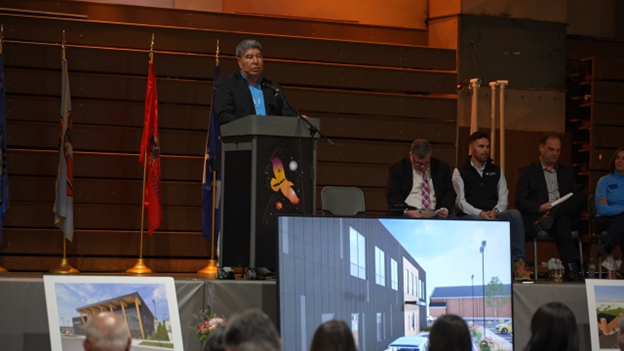
Justin McKinsey/MTN News
Leonard Smith Jr, the CEO of the Billings Urban Indian Health and Wellness Center, speaks at groundbreaking ceremony.

The expansion of the Billings Urban Indian Health and Wellness Center with the new Eagle Seeker Clinic marks a significant milestone for urban Native health in Montana. As most American Indian and Alaska Native people live in urban areas, the development of spaces that honor culture, expand services, and strengthen access to care is essential. This new clinic reflects a community-driven vision for a setting where relatives can receive medical, behavioral health, and wellness services in an environment built with their needs at the forefront. The Eagle Seeker Clinic will allow the organization to grow its programs, increase its capacity, and continue offering care that is culturally grounded and responsive.

NCUIH commends the leadership and staff in Billings for advancing an effort that demonstrates what is possible when communities advocate for the resources and infrastructure they deserve. This investment will benefit Native people in Billings for generations to come.

image_pdfPDFimage_printPrint

Indian Health Service Releases Agency Realignment Narrative and Re-Org Chart, Announces Expanded Schedule for Tribal Consultations

On December 5, 2025, the IHS Chief of Staff released a letter to Tribal and Urban Indian Leaders in response to requests for additional opportunities and added more in-person sessions and a virtual Tribal Consultation. The IHS also released a realignment narrative and a draft re-organization chart. It is noted a third enclosure of Frequently Asked Questions will be posted soon.

The letter states:

The IHS will now host a total of nine Consultation sessions, which include the five originally announced on November 13 and four additional sessions requested by Tribes and Urban Indian Organizations, including a virtual Consultation. Supporting materials include an executive narrative, a draft organizational chart, and frequently asked questions available as “Enclosures” at www.ihs.gov/newsroom/triballeaderletters.

Additional Information

IHS

The IHS Chief of Staff writes to Tribal Leaders and Urban Indian Organization Leaders to announce an expanded schedule of Tribal Consultations and Urban Confer to seek your engagement on the proposed IHS realignment.

NCUIH

Indian Health Service Announces Next Phase of Agency Realignment, Invites Tribal and Urban Leader Feedback (November 30, 2025)

  • NCUIH submitted comments in response to the first round of confer on August 28, 2025, and recommended additional consultation and confers to provide more opportunities for feedback.
image_pdfPDFimage_printPrint

New Mental Health App for Native Veterans

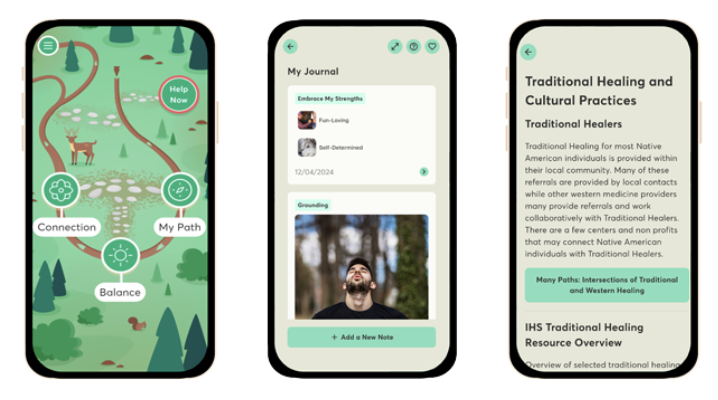
The Department of Veterans Affairs has launched the Veterans Wellness Path app, created with input from Native American and Alaska Native Veterans. The app supports the transition from military service to home and offers tools to strengthen balance and connection with self, family, community, and environment. Features include daily check-ins, wellness tips, and support for issues like PTSD. Developed by VA’s Office of Rural Health in partnership with the National Center for PTSD’s Mobile Mental Health Program, the app is available to any Native Veteran seeking mental health support.

image_pdfPDFimage_printPrint

CMS Releases Informational Bulletin about Medicaid Provisions with Summary of Tribal Exceptions in the One Big Beautiful Bill Act

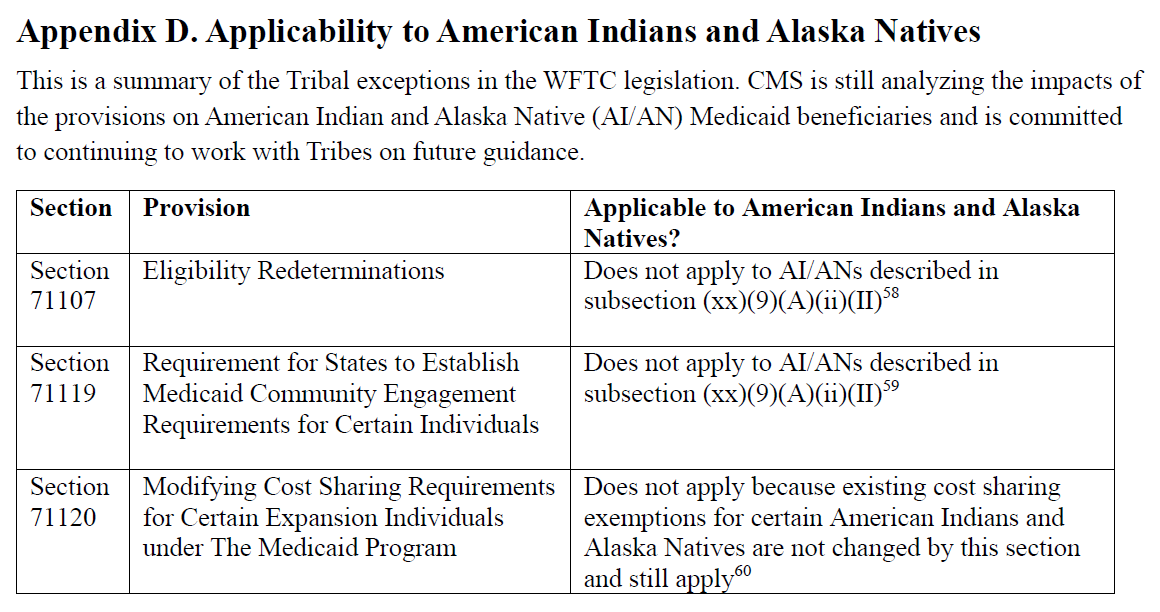
The Centers for Medicare & Medicaid Services (CMS) recently released an informational bulletin outlining updates to Medicaid and CHIP included in the One Big Beautiful Bill Act, which is also known as the “Working Families Tax Cut” legislation. The bulletin features a summary of exceptions for American Indian and Alaska Native people in the Act (see page 32). CMS notes that it is still reviewing how these provisions affect AI/AN Medicaid beneficiaries and is committed to collaborating with tribes to develop further guidance. NCUIH has advocated to CMS to continue to consult with Tribes to ensure proper implementation of exemptions for American Indian and Alaska Native people.

Additional Information

On July 4, 2025, the President signed the One Big Beautiful Bill Act (OBBBA) into law. The OBBBA is a major bill that delivers many elements of President Trump’s legislative agenda, including new requirements for access to Medicaid and SNAP. Fortunately, Indians, Urban Indians, California Indians, and individuals determined eligible as an Indian for the Indian Health Service under regulations promulgated by the Secretary are exempted from the Medicaid requirements in the OBBBA and included in exemptions for the Supplemental Nutrition Assistance Program (SNAP) work requirements.

image_pdfPDFimage_printPrint