Senators Cortez Masto and Rounds Introduce NCUIH-Endorsed Bipartisan Bill to Elevate Indian Health Service Leadership Within HHS

On February 3rd, 2026, U.S. Senators Catherine Cortez Masto (D-NV) and Mike Rounds (R-SD) introduced bipartisan legislation to elevate the Director of the Indian Health Service (IHS) to Assistant Secretary for Indian Health within the U.S. Department of Health and Human Services (HHS). Companion legislation was introduced in the House of Representatives by Congressmen Greg Stanton (D-Ariz.-04) and David Joyce (R-Ohio-14).

The Stronger Engagement for Indian Health Needs Act would formally elevate the IHS Director’s position within the federal government, strengthening Tribal representation in federal health decision-making and reinforcing the federal government’s trust responsibility to provide health care to American Indian and Alaska Native people.

“The shockingly unequal health outcomes in Indian Country paint a clear picture: our country has failed to live up to our obligation to provide quality health care for Tribal communities,” said Senator Cortez Masto. “This bipartisan legislation would be an important step toward giving IHS the tools and authority it needs to ensure everyone has access to excellent, affordable health care.”

“The Indian Health Service has an obligation to care for tribal members across the United States, and we have an obligation to make improvements to the system to improve patient care,” said Senator Rounds. “Our legislation would raise the role of IHS Director to Assistant Secretary for Indian Health, allowing them more authority to recruit and retain staff within the IHS system.”

“Effective healthcare delivery requires empowered leadership, and elevating the IHS Director to Assistant Secretary is a critical step in moving Indian health from an afterthought to a primary focus of federal healthcare policy,” said Francys Crevier (Algonquin), CEO of NCUIH.

image_pdfPDFimage_printPrint

NCUIH February Policy Update: Federal Budget Formulation, Appropriations, and Advocacy Requests for Urban Indian Organizations

In this Edition:

  • 🏛 National Policy Convenings: State of Indian Nations, Executive Council Winter Session, Tribal Summit, and Family Welfare Hill Day
  • 💰 Fiscal Year 2028 Indian Health Service Budget Formulation: Urban Indian Health Elevated Across Areas
  • 💰 Appropriations Updates: Labor–Health and Human Services
  • 🏥 Medicaid Federal Medical Assistance Percentage Advocacy
  • 🏥 Indian Health Service Realignment: Comments Due February 27
  • 💡 Rural Health Transformation Fund: Request for Urban Indian Organizations
  • 📅 Upcoming Events and Key Dates
  • 📍 NCUIH Update: 2026 Annual Conference and Awards Nominations

National Policy Convenings Shaping the Year Ahead

February brought several major national convenings where urban Indian health priorities were elevated and reinforced.

National Congress of American Indians State of Indian Nations and Executive Council Winter Session

February 9–12, 2026 | Washington, District of Columbia

NCUIH attended the National Congress of American Indians State of Indian Nations Address and Executive Council Winter Session to engage with Tribal leaders and partners from across Indian Country.

February 11, 2026
During the Winter Session, NCUIH co-led the Family Welfare Hill Day preparation session alongside:

  • National Indian Health Board
  • National Congress of American Indians
  • National Indian Child Welfare Association

This session strengthened coordinated advocacy efforts ahead of congressional engagement on family welfare and health priorities.

Indian Health Service 70th Anniversary Tribal Summit

February 12, 2026
At the Indian Health Service 70th Anniversary Tribal Summit, NCUIH was honored for its commitment to improving health for Native people living in urban areas.

Additionally, Department of Health and Human Services (HHS) Secretary Kennedy addressed Tribal leaders and recommitted to strengthening Indian health. He announced that HHS will be transferring $1 billion in unused HHS funds to address IHS priority infrastructure projects starting in FY 2027. Secretary Kennedy mentioned that currently there is an $8 billion construction deficit, and the transfer will target “shovel-ready” projects with facility conditions currently hindering patient care and workforce recruitment.

Secretary Kennedy also highlighted the renewed behavioral health efforts from the Indian Health Service and the Substance Abuse and Mental Health Services Administration, the need for continued engagement with Tribal Nations, and the importance of Native-led care models.

National Health Council Health Leadership Conference


February 13, 2026
NCUIH CEO, Francys Crevier J.D. (Algonquin), joined Tracy Hart, CEO of the Osteogenesis Imperfecta Foundation, and Brian Smith of Merck & Co. at the National Health Council Health Leadership Conference.

The discussion elevated urban Indian health within national patient-centered care conversations and highlighted the importance of including Urban Indian Organizations in broader health system discussions.

Fiscal Year 2028 Indian Health Service Budget Formulation: Urban Indian Health Elevated Across Areas

At the Indian Health Service Tribal Budget Formulation Work Session, Tribal representatives discussed how Indian Health Service funding is prioritized and distributed. Urban Indian Organizations and NCUIH participated and emphasized the need for additional resources for urban Indian health.

Multiple Indian Health Service Areas elevated urban Indian health as a priority.

Highlights include: 
  • Bemidji Area: “Urban Health” listed as Priority 6; recommended $234 million increase.
  • Billings Area: “Urban Indian Health” listed as Priority 8; recommended $588,364,000.
  • California Area: “Urban” listed as Hot Topic 1.
  • Great Plains Area: “Urban Indian Health” listed as Priority 7; recommended $382,438,000.
  • Nashville Area: Included funding increases for Urban Indian Health Programs in standing priorities.
  • Navajo Area: “Urban” listed as Priority 3; recommended $2.1 billion.
  • Oklahoma City Area: “Urban Health” listed as Priority 5; recommended $127.4 million; also elevated 100 percent Federal Medical Assistance Percentage as a hot topic.
  • Phoenix Area: Included increased Urban Indian Health funding as Hot Issue 12.
  • Portland Area: Recommended a 2 percent increase for Urban Health.
  • Tucson Area: Recommended $383 million to expand Urban programs.

Strong area-level prioritization reinforces the need for sustained federal investment in urban Indian health nationwide.

Appropriations Updates

Labor–Health and Human Services Appropriations 

  • On February 3, 2026, Congress passed a three-bill appropriations minibus for fiscal year (FY) 2026, which included the appropriations bill for Labor, Health and Human Services, Education, and Related Agencies (Labor-HHS).

The bill included key provisions for Indian Country:

  • $116.6 billion for HHS
  • $200 million for SDPI, $41 million increase.
  • $27 million, $3 million increase, for the Good Health and Wellness in Indian Country program
  • $9 million, $3 million increase, for the Improving Native American Cancer Outcomes program
  • $25.67 million, $2 million increase, for the Tribal Behavioral Health Grants (Native Connections)
  • No less than $6 million for the Minority HIV/AIDS Fund – Tribal Set Aside
  • 15% Tribal set-aside (includes UIOs) for the National Health Service Corps

Indian Health Service Realignment:
Comments Due February 27, 2026

The Indian Health Service is accepting written comments on its proposed agency realignment.

Deadline: February 27, 2026

Urban Indian Organizations are encouraged to submit feedback.

Rural Health Transformation Fund:
Let NCUIH Know

If your Urban Indian Organization receives funding through the Rural Health Transformation Fund, please notify NCUIH so we can better understand the impact and support continued engagement.

Upcoming Events and Key Dates Requests for Information

  • February 27, 2026:Indian Health Service Realignment Comments Due
  • March 6, 2026:Early Bird Registration rates for NCUIH Annual Conference end
  • March 13, 2026:NCUIH Annual Conference Award Nominations Close
  • April 27–30, 2026: 2026 NCUIH Annual Conference, The Westin Downtown, Washington, District of Columbia

2026 NCUIH Annual Conference

Early Bird Registration Ends Next Month

Join us April 27–30, 2026, in Washington, D.C., as NCUIH marks the 50th anniversary of the Indian Health Care Improvement Act (IHCIA)—a landmark commitment to the health and well‑being of American Indians and Alaska Natives—and reflects on five decades of progress, collaboration, and continued commitment to Native health.

The conference provides a vital platform for:
  • Urban Indian Organizations
  • Health care professionals
  • Policymakers
  • Community leaders and advocates

Register by March 6 to receive the Early Bird rate.

Call for Award Nominations

We are now accepting nominations for the 2026 NCUIH Annual Conference Awards, recognizing individuals whose leadership and service have strengthened Urban Indian health systems and uplifted Native communities across the country.

 2026 Award Categories
  • UIO Staff Member of the Year
  • UIO Visionary Award
  • Urban Indian Legacy Award
  • Tribal Leader Impact Award

We encourage Urban Indian Organizations, Tribal leaders, and partners to submit nominations honoring individuals who are making a lasting impact in urban Native health.

Submissions due Friday, March 13, 2026 by 11:59 PM ET.

Recent NCUIH Policy Blogs

  1. Friendship House Celebrates Investment in Healing-Centered Housing in San Francisco
    February 3, 2026/in Policy Blog/by River Carroll
  2. Congress Passes Labor Health and Human Services Spending Bill, Includes $200 million for Special Diabetes Program for Indians
    February 4, 2026/in Policy Blog/by Jeremy Grabiner

About NCUIH

The National Council of Urban Indian Health (NCUIH) is a national representative for the 41 Urban Indian Organizations contracting with the Indian Health Service under the Indian Health Care Improvement Act. NCUIH is devoted to the support and development of high quality and accessible health and public health services for American Indian and Alaska Native people living in urban areas.

NCUIH respects and supports Tribal sovereignty and the unique government-to-government relationship between our Tribal Nations and the United States. NCUIH works to support those federal laws, policies, and procedures that respect and uplift Tribal sovereignty and the government-to-government relationship. NCUIH does not support any federal law, policy, or procedure that infringes upon or in any way diminishes Tribal sovereignty or the government-to-government relationship.
image_pdfPDFimage_printPrint

Congress Passes Labor Health and Human Services Spending Bill, Includes $200 million for Special Diabetes Program for Indians

On February 3, 2026, Congress passed a three-bill appropriations minibus for fiscal year (FY) 2026, which included the appropriations bill for Labor, Health and Human Services, Education, and Related Agencies (Labor-HHS). The bill includes $116.6 billion for the Department of Health and Human Services (HHS), which is $100 million below the FY 2025 levels and $22 billion above the President’s request. The bill also includes $200 million for the Special Diabetes Program for Indians (SDPI), which represents a $41 million increase, the largest increase for the program in 22 years.

Other Key provisions include:

  • $9 million, $3 million increase, for the Improving Native American Cancer Outcomes program 
  • $27 million, $3 million increase, for the Good Health and Wellness in Indian Country program 
  • $25.67 million, $2 million increase, for the Tribal Behavioral Health Grants (Native Connections) 
  • No less than $6 million for the Minority HIV/AIDS Fund – Tribal Set Aside.

Background 

NCUIH worked closely with Appropriators to advocate for increased funding for Indian Country. In written testimony, NCUIH advocated for $10 million for the Improving Native American Cancer Outcomes program, $30 million for the Good Health and Wellness in Indian Country program, and to protect funding for HIV/AIDS treatment and prevention.

Next Steps

The bill will now head to the President to sign.

Bill Highlights

Line Item FY 2025 Enacted FY 2026 President’s Budget Request FY 2026 Senate Committee Passed FY 2026 House Committee Passed Final FY 2026 Appropriations
Health Resources and Services Administration $8.9 billion Fold into Administration for a Healthy America (AHA) $8.86 billion $7.4 billion $8.95 billion
Substance Abuse and Mental Health Services Administration $7.4 billion Fold into AHA $7.4 billion $7.1 billion $7.4 billion
National Institute of Health $48.6 billion $27.5 billion $48.7 billion $47.8 billion $48.7 billion
Centers for Disease Control $9.2 billion Fold into AHA $9.15 billion $7.5 billion $9.2 billion
Good Health and Wellness in Indian Country $24 million $24 million $30 million $27 million
Improving Native American Cancer Outcomes $6 million $6 million $14 million $9 million
Ryan White HIV/AIDS Program $2.57 billion $2.50 billion $2.57 billion $2.04 billion $2.57 billion
Ending the HIV Epidemic $165 million $165 million $165 million $165 million $165 million
Minority HIV/AIDS Fund $60 million Eliminated $60 million $20 million $56 million
Minority HIV/AIDS Fund – Tribal Set Aside $5 million $5 million No less than $6 million No less than $6 million
Tribal Behavioral Health Grants (Native Connections) $23.67 million Eliminated. Created a new behavioral health program under AHA $23.67 million $30 million $25.67 million

Additional Key Provisions:

Medicare Telehealth Flexibilities: Extended through December 31, 2027.

Health Resources and Services Administration

Federal Office of Rural Health Policy: $417 million
Native Hawaiian Health Care Program: $27 million
National Health Service Corps: $130 million (15% Tribal set-aside)

  • Tribal Set-Aside—The Committee includes a set-aside of 15 percent within the total funding provided for NHSC to support awards to participating individuals that provide health services in Indian Health Service facilities, Tribally-operated health programs, and Urban Indian Health programs.
Centers for Disease Control and Prevention

Good Health and Wellness in Indian Country: $27 million – $3 million increase
Public Health Infrastructure: $360 million ($10.8 million Tribal set-aside)

  • The agreement includes a new requirement that three percent of total PHI funding be designated specifically for Tribes and Tribal organizations. The agreement further directs that no less than 70 percent of total PHI funding be awarded to State, local, and Territorial public health departments.
Office of the Secretary – General Departmental Management

Minority HIV/AIDS Fund: $56 million ($6 million Tribal set-aside)

  • The agreement includes a Tribal set-aside of no less than $6,000,000 within the Minority HIV/AIDS Prevention and Treatment program.
Substance Abuse and Mental Health Services Administration

Eating Disorders: $2 million
Substance Abuse Prevention Services: $205 million
Tribal Behavioral Grants (Native Connections): $25.67 million
Zero Suicide: $23.8million
American Indian and Alaska Native Set Aside: $4.4 million
Minority AIDS Appropriations: $9.2 million
Mental Health Awareness Training: $28 million
Strategic Prevention Framework: $137.5 million
Mental Health Services Block Grant: $991.5 million
988 Suicide & Crisis Lifeline: $534.6 million
Substance Use Prevention, Treatment, and Recovery Services Block Grant: $1.9 billion
State Opioid Response Grants: $1.6 billion

  • Within the amount provided, the bill includes a set-aside for Indian Tribes and Tribal organizations of not less than 4.25 percent.
National Institute on Minority Health and Health Disparities

Improving Native American Cancer Outcomes: $9 million – $3 million increase
Native Hawaiian/Pacific Islander Health Research Office: $5 million – $1 million increase

Important Behavioral and Mental Health Provisions

Medication-Assisted Treatment for Prescription Drug and Opioid Addiction: $114 million

  • Tribal Set Aside: $15.5 million

Peer-Support Specialists: $15 million
Infant and Early Childhood Mental Health Program: $15 million

Administration for Community Living

Native American Caregiver Support Program: $14 million

image_pdfPDFimage_printPrint

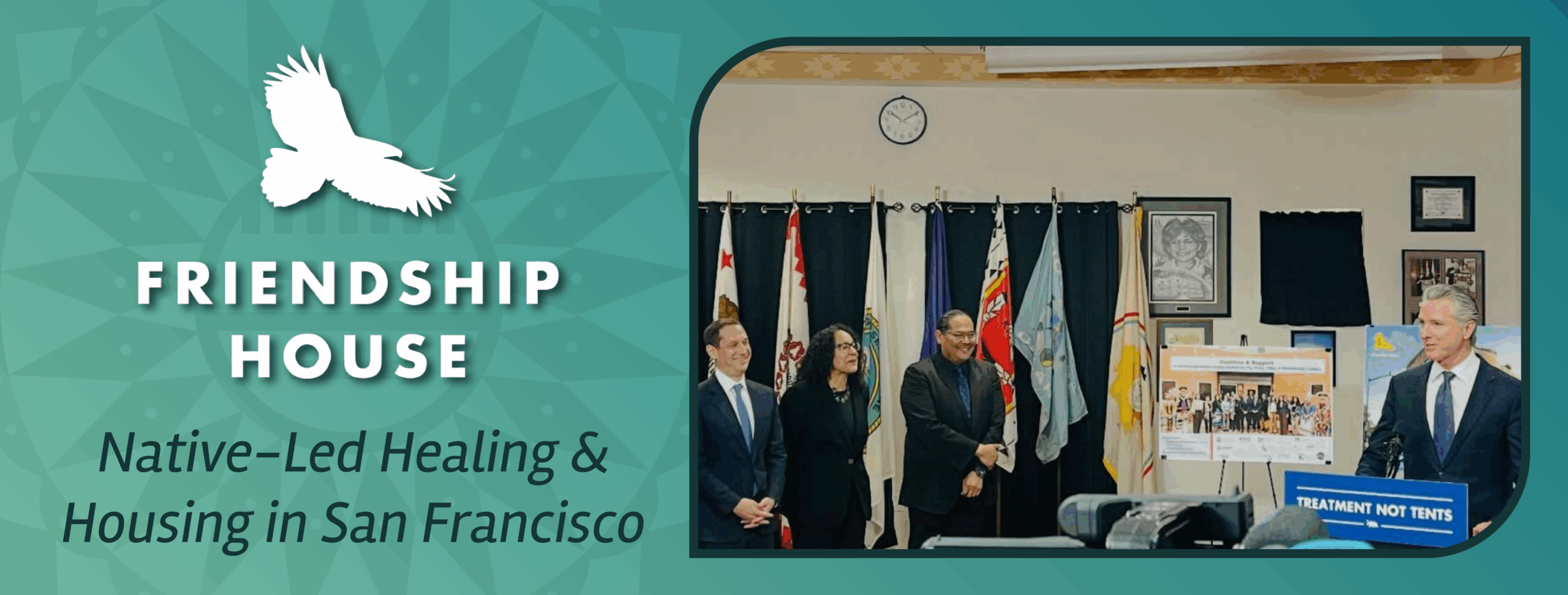
Friendship House Celebrates Investment in Healing-Centered Housing in San Francisco

On January 16, 2026, Friendship House Association of American Indians welcomed California Governor Gavin Newsom and state officials to celebrate a landmark $31.4 million state investment in The Village SF, a Native-led approach to housing and healing in San Francisco.

The Village SF will serve as a comprehensive model by integrating recovery housing, behavioral health services, workforce pathways, and cultural programming in one location. This model reflects Friendship House’s more than 60 years of service to Native people through culturally grounded, trauma-informed care. Once fully operational, The Village SF is projected to serve over 7,000 community members annually.

NCUIH celebrates Friendship House’s leadership in demonstrating how Urban Indian Organizations can deliver community-driven solutions that strengthen health, stability, and connection for future generations.

image_pdfPDFimage_printPrint