Syphilis Rates Among American Indian and Alaska Native Communities
The following resource was developed by the National Council of Urban Indian Health (NCUIH) in 2025 to highlight disparities in syphilis experienced by the American Indian and Alaska Native (AI/AN) population.
Primary & Secondary Syphilis Disparities
Syphilis is a sexually transmitted infection (STI) that is transmitted through direct contact with an infected syphilis sore during oral, vaginal, or anal sex (Centers for Disease Control and Prevention [CDC], 2025a). Syphilis has four key stages: the primary stage (characterized by minimal sores typically found in, on, or around the genitals or mouth), secondary stage (characterized by sores and/or rashes in the mouth, vagina, or anus), latent stage (a period where there are no visible signs or symptoms), and tertiary stage (in which syphilis spreads to different organ systems, typically occurring ten to thirty years after the infection began) (2025a). Primary and secondary syphilis are considered the most infectious stages of syphilis (Centers for Disease Control and Prevention [CDC], 2024). If left untreated, syphilis can cause damage to the heart, brain and nervous system, and more (CDC, 2025a).
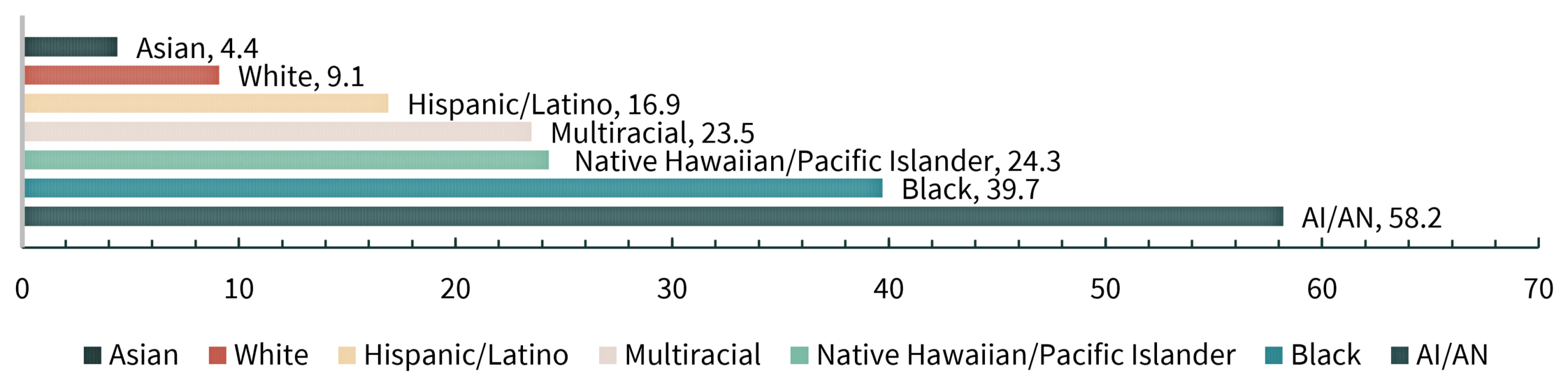
American Indian and Alaska Native (AI/AN) people experience disproportionately higher rates of primary and secondary syphilis compared to their counterparts (see Figure 1). In 2023, the rate of primary and secondary syphilis was 15.8 per 100,000 persons for the total population and 58.2 per 100,000 persons for the AI/AN population (Centers for Disease Control and Prevention, 2024). Specifically, the AI/AN population had the highest rate of primary and secondary syphilis in 2023 of all racial/ethnic groups in the United States, a rate 3.7 times that of the total population and 6.4 times that of their White counterparts (2024).
Figure 1. 2023 Primary and Secondary Syphilis Rates by Race/Ethnicity1
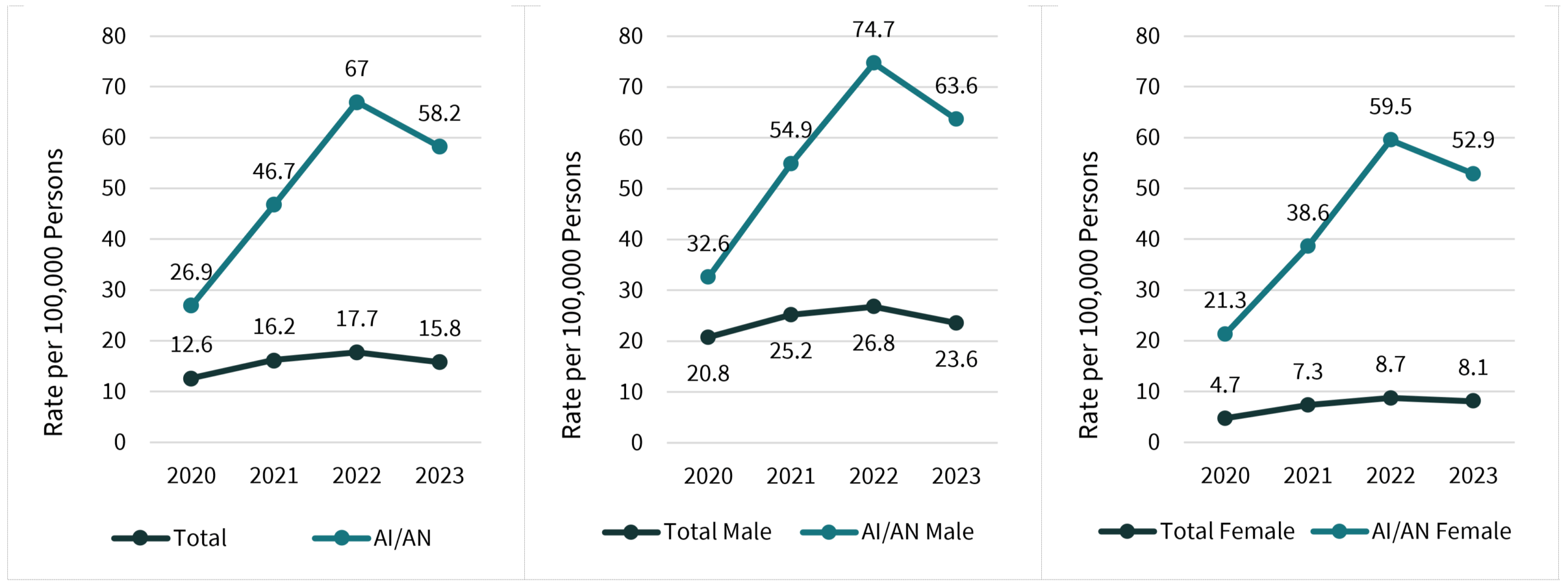
Primary and secondary syphilis disparities have also worsened disproportionately for the AI/AN population compared to the total population (see Figure 2). Between 2020 to 2023, the total rate of primary and secondary syphilis in the United States increased by 25.4 percent, while the AI/AN rate of primary and secondary syphilis increased by 116.3 percent (Centers for Disease Control and Prevention [CDC], 2021; CDC, 2022; CDC, 2023; CDC, 2024).
Disparities in primary and secondary syphilis also affect AI/AN males and females disproportionately compared to their counterparts (see Figure 2). In 2023, the male AI/AN rate of primary and secondary syphilis per 100,000 persons was approximately 2.7 times that of the national rate (CDC, 2021; CDC, 2022; CDC, 2023; CDC, 2024). Between 2020 to 2023, the rate of primary and secondary syphilis increased by 13.5 percent for all males and 95.1 percent for AI/AN males (CDC, 2021; CDC, 2022; CDC, 2023; CDC, 2024). In comparison, the female AI/AN rate of primary and secondary syphilis per 100,000 persons was approximately 6.5 times that of the national rate (CDC, 2021; CDC, 2022; CDC, 2023; CDC, 2024). Between 2020 to 2023, the rate of primary and secondary syphilis increased by 72.3 percent for all females and 148.4 percent for AI/AN females (CDC, 2021; CDC, 2022; CDC, 2023; CDC, 2024). While primary and secondary syphilis rates decreased between 2022 and 2023 (likely due to increased STI prevention efforts, such as the nationally coordinated response spearheaded by the National Syphilis and Congenital Syphilis Syndemic Task Force), further intervention is needed to address these impacts of these disparities on the AI/AN population (CDC, 2024).
Figure 2. Trends in Primary and Secondary Syphilis, 2020-20232
Congenital Syphilis Disparities
Congenital syphilis is a disease that occurs when syphilis is passed from pregnant people to their babies during pregnancy (Centers for Disease Control and Prevention, 2025b). Congenital syphilis can affect pregnancy by causing miscarriage, stillbirth, prematurity, low birth weight, or even infant mortality (2025b). Babies born with congenital syphilis can experience issues like bone deformity, severe anemia, jaundice, blindness or deafness, and more (2025b).
AI/AN people experience disproportionately higher rates of congenital syphilis compared to their counterparts (see Figure 3). In 2023, the rate of congenital syphilis was 105.8 per 100,000 live births for the total population and 680.8 per 100,000 live births for the AI/AN population (Centers for Disease Control and Prevention [CDC], 2024). Specifically, the AI/AN population had the highest rate of congenital syphilis in 2023 of all racial/ethnic groups in the United States, a rate 6.4 times that of the total population and 11.9 times that of their White counterparts (2024).
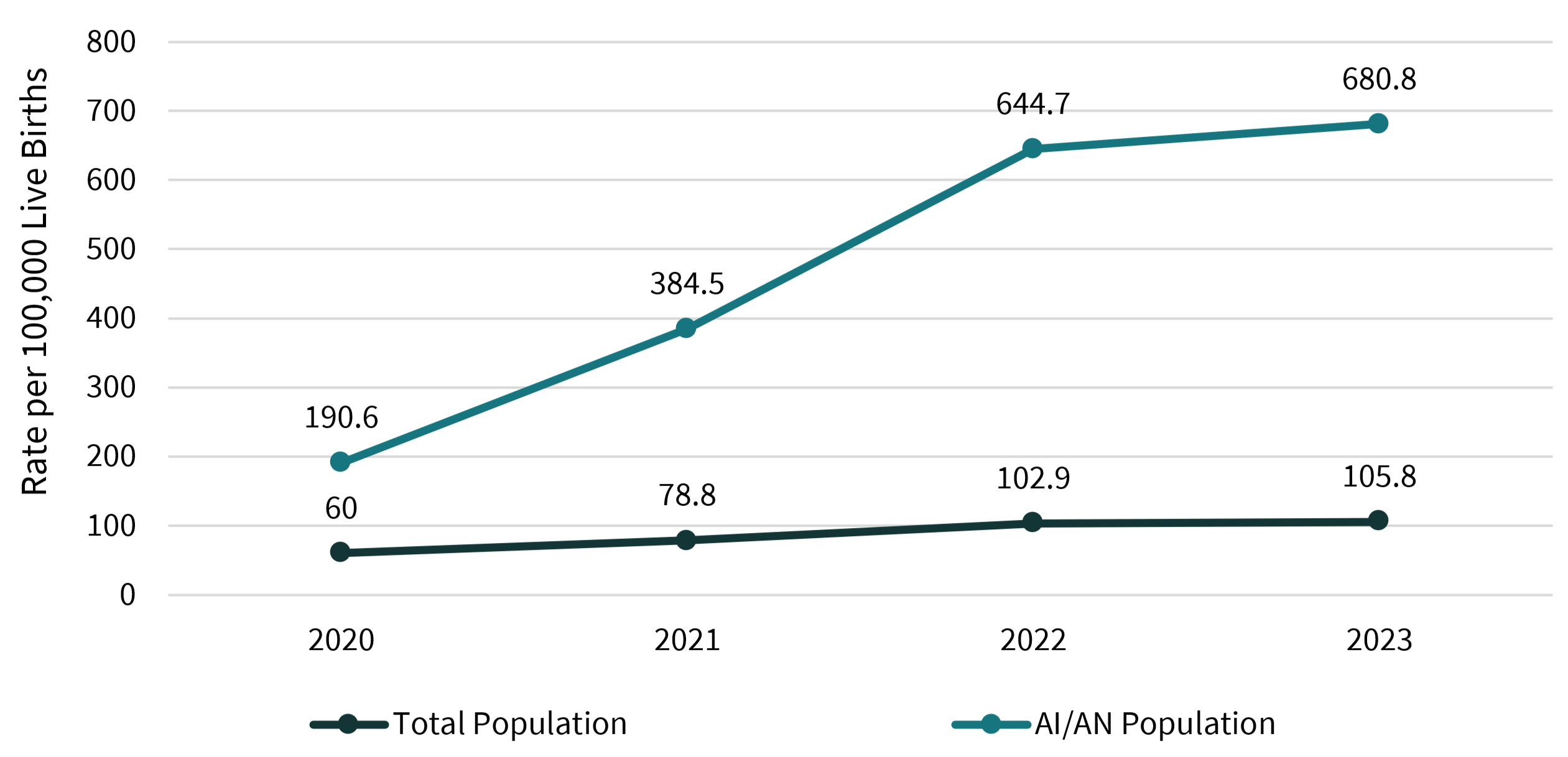
Congenital syphilis disparities have also worsened disproportionately for the AI/AN population compared to the total population (see Figure 4). Between 2020 to 2023, the rate of congenital syphilis per 100,000 live births increased by 76.3 percent for the total population, compared to an increase of 257.2 percent for the AI/AN population (CDC, 2021; CDC, 2022; CDC, 2023; CDC, 2024).
Figure 3. 2023 Congenital Syphilis (Rate per 100,000 Live Births) by Race/Ethnicity3
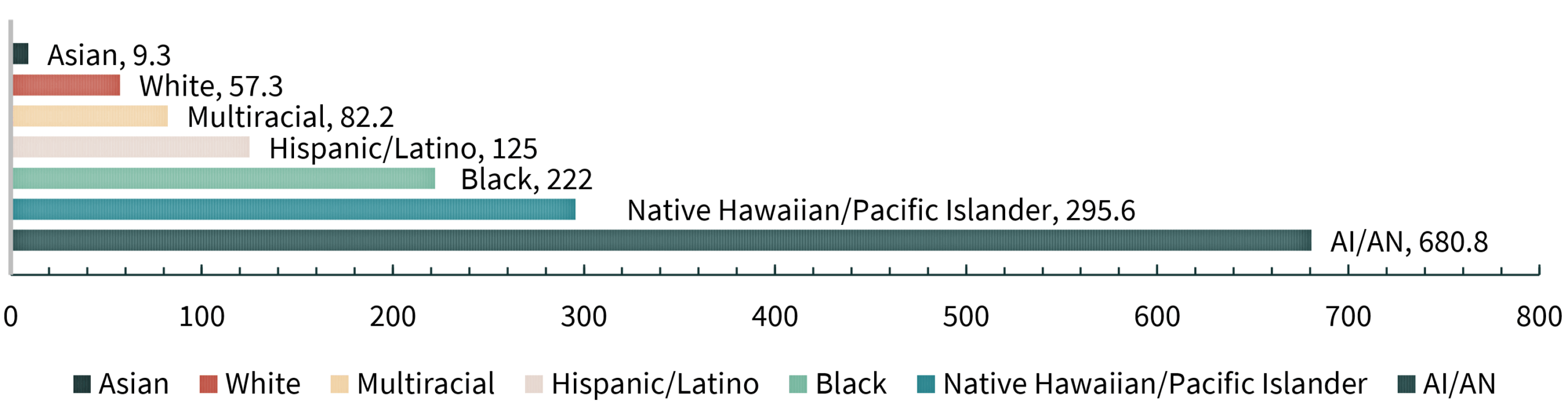
Figure 4. Congenital Syphilis (Rate per 100,000 Live Births), 2020-20234
Resources
These disparities highlight the need for improved access to syphilis prevention, testing, and treatment for AI/AN populations. Urban Indian Organizations (UIOs) play a crucial role in providing programs and healthcare to address syphilis disparities affecting urban AI/AN populations.
The National Council of Urban Indian Health (NCUIH) has developed an HIV and STI web page dedicated to providing relevant information and tools for UIOs serving urban AI/AN communities, including guides and infographics on sexually transmitted infection (STI) disparities and best practices, culturally-tailored educational videos on STIs, recordings of webinars and trainings such as Strengthening Syphilis Care in Indian Country, and more.
Additionally, NCUIH’s Knowledge Resource Center (KRC) is the first searchable resource center devoted to the dissemination of knowledge on Urban Indian health across the United States, and it features many resources on STIs and syphilis. Use the STI/STD tag to directly search for resources on STI research, prevention, best practices, and more in the KRC.
NCUIH has also developed a new Syphilis Rates Among American Indian and Alaska Native Communities infographic summarizing these AI/AN syphilis disparities which can be downloaded here.
Additional resources:
- Indian Country ECHO Syphilis Resource Hub
- CDC Syphilis Pocket Guide for Providers
- Medicaid Fact Sheet: Syphilis and Congenital Syphilis Resources
- CDC Syphilis Fact Sheet
- We R Native Sexual Health Resources
- IHS Syphilis Resources
- Reproductive Health National Training Center Syphilis Resource List
- I Want the Kit: STI Testing Resources
- IHS STI Toolkit
- CDC Syphilis Informational Resources by Audience
- SAMHSA Syphilis News and Resources
- Healthy People 2030: Female Syphilis Reduction
- Healthy People 2030: Congenital Syphilis Reduction
- Healthy People 2030: MSM Syphilis Reduction
References
Centers for Disease Control and Prevention. (2021). Sexually Transmitted Disease Surveillance 2020. https://www.cdc.gov/sti-statistics/media/pdfs/2024/07/2020-SR-4-10-2023.pdf.
Centers for Disease Control and Prevention. (2022). Sexually Transmitted Disease Surveillance 2021. https://www.cdc.gov/sti-statistics/media/pdfs/2024/07/2021-STD-Surveillance-Report-PDF_ARCHIVED-2-16-24.pdf.
Centers for Disease Control and Prevention. (2023). Sexually Transmitted Infections Surveillance 2022. https://www.cdc.gov/sti-statistics/media/pdfs/2024/11/2022-STI-Surveillance-Report-PDF.pdf.
Centers for Disease Control and Prevention. (2024). Sexually Transmitted Infections Surveillance 2023. https://www.cdc.gov/sti-statistics/media/pdfs/2025/09/2023_STI_Surveillance_Report_FINAL_508.pdf.
Centers for Disease Control and Prevention. (2025a, January 30). About Syphilis. https://www.cdc.gov/syphilis/about/index.html.
Centers for Disease Control and Prevention. (2025b, January 31). About Congenital Syphilis. https://www.cdc.gov/syphilis/about/about-congenital-syphilis.html.
1Data was sourced from the Sexually Transmitted Infections Surveillance 2023 report (Centers for Disease Control and Prevention, 2024). Rates for primary and secondary syphilis are presented as rates per 100,000 persons.
2Data was sourced from the Sexually Transmitted Infections Surveillance reports from 2020, 2021, 2022, and 2023 (CDC, 2021–2024). Rates for primary and secondary syphilis are presented as rates per 100,000 persons.
3Data was sourced from the Sexually Transmitted Infections Surveillance 2023 report (Centers for Disease Control and Prevention, 2024). Rates for congenital syphilis are presented as rates per 100,000 live births.
4Data was sourced from the Sexually Transmitted Infections Surveillance reports from 2020, 2021, 2022, and 2023 (CDC, 2021–2024). Rates for congenital syphilis are presented as rates per 100,000 live births.